
Why Your Business Needs Technical SEO in 2026
why technical SEO matters in 2026. Improve crawling, indexing, Core Web Vitals, structured data, mobile usability, and AI search visibility for your business website.
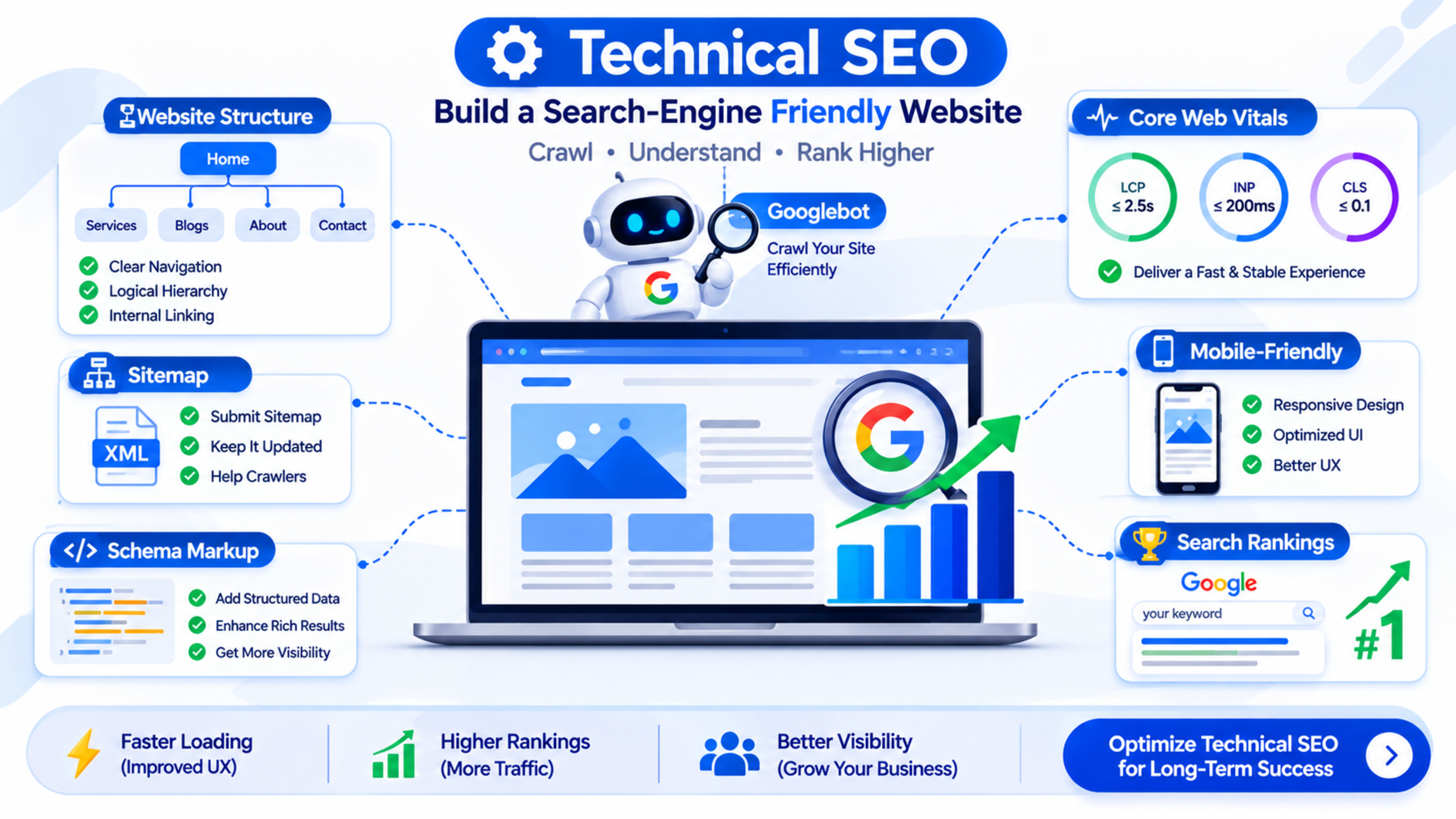
Why Your Business Needs Technical SEO in 2026
Your business needs technical SEO in 2026 because search engines and AI systems must be able to crawl, render, index, and understand your website before they can rank or recommend it. Technical SEO is the foundation that makes your content, keywords, and backlinks actually work.
You can publish excellent content and build strong links, but if Google cannot access your pages, your site loads slowly, or your structure confuses crawlers, your rankings and enquiries will suffer.
Technical SEO is no longer just about fixing broken links. In 2026, it also supports mobile usability, Core Web Vitals, structured data, JavaScript rendering, security, and visibility in AI-powered search features such as Google AI Overviews.
What is technical SEO?
Technical SEO is the process of improving the technical foundation of your website so search engines can find, understand, and rank your pages effectively.
It includes:
Crawlability
Indexation
Website architecture
Internal linking
XML sitemaps
Robots.txt
Canonical tags
Mobile usability
Page speed
Core Web Vitals
HTTPS security
Structured data
Duplicate content control
JavaScript rendering
Server response time
Broken links and redirects
Google says a page must meet minimum technical requirements to be eligible for indexing: Googlebot must not be blocked, the page must return a successful HTTP 200 status code, and the page must contain indexable content.
Why technical SEO matters in 2026
1. Search engines must be able to access your site
If Google cannot crawl your website, it cannot rank it.
Common technical problems include:
Pages blocked by robots.txt
noindextags left on important pagesBroken internal links
Incorrect canonical tags
Server errors
Slow server response
Poor JavaScript rendering
Missing XML sitemap
A page may meet Google’s minimum requirements but still not be indexed. Indexing is not guaranteed, so technical SEO helps remove barriers that prevent Google from finding and understanding your pages.
2. Mobile users are now the majority
Most people browse websites on mobile devices. If your website is difficult to use on a phone, visitors leave quickly, and search engines receive negative engagement signals.
Mobile technical SEO includes:
Responsive design
Readable text without zooming
Large tap targets
No horizontal scrolling
Fast mobile loading
Compressed images
Minimal intrusive pop-ups
Mobile-friendly navigation
Mobile performance still lags behind desktop. In September 2026, only 52.8% of mobile origins passed Core Web Vitals, compared with 60.8% on desktop.
3. Core Web Vitals affect user experience
Core Web Vitals measure real-world user experience.
The three main metrics are:
Metric | What it measures | Good threshold |
|---|---|---|
LCP | Loading performance | 2.5 seconds or less |
INP | Interactivity and responsiveness | 200 milliseconds or less |
CLS | Visual stability | 0.1 or less |
A slow or unstable website frustrates users. A 100-millisecond delay can reduce conversion rates by 7%, and 53% of mobile visits are abandoned when a page takes longer than three seconds to load.
Core Web Vitals are not the only ranking factor, but poor performance can put you at a disadvantage, especially when competing websites have similar content quality.searchengineland+1
4. Technical SEO supports AI search visibility
AI-powered search features, including Google AI Overviews, rely on Google’s core search and quality systems. Google’s guidance says a page must be indexed and eligible to appear in Google Search with a snippet before it can be shown in generative AI features.
This means technical SEO now affects:
Whether AI systems can access your pages
Whether your content can be rendered correctly
Whether your pages are eligible for AI Overviews
Whether structured data helps AI understand your business
Whether your website appears in AI-generated answers
If your website is technically weak, your content may never reach the stage where it can be considered for AI search visibility.
5. Structured data helps search engines understand your business
Structured data, also called schema markup, helps search engines understand the meaning of your content.
For a business website, useful schema types include:
OrganizationLocalBusinessProfessionalServiceServiceProductArticleBlogPostingFAQPageReviewBreadcrumbList
Structured data can support rich results, improve entity understanding, and help AI systems interpret your services, location, reviews, and business details.
Google recommends following best practices for structured data, JavaScript, images, and videos so search engines can understand all parts of your page.
Key technical SEO areas for 2026
Crawlability
Crawlability means search engines can access your pages.
Check:
Robots.txt rules
Internal links
Crawl depth
Broken links
Redirect chains
Server errors
XML sitemap
Crawl budget
Submit an XML sitemap through Google Search Console and request recrawling when important pages change.
Indexation
Indexation means Google has stored and understands your pages.
Check:
Important pages are indexed
No accidental
noindextagsCorrect canonical tags
No duplicate content
Correct HTTP status codes
Proper use of
noindex,nofollow, and redirects
Use Google Search Console’s URL Inspection tool to check whether a page is indexed and diagnose problems.
Website architecture
A clear website structure helps both users and search engines.
Use a simple structure:
textHome├── Services│ ├── Web Development│ ├── SEO Services│ └── AI Automation├── Blog├── About└── Contact
Important pages should be reachable within a few clicks from the homepage. Use descriptive internal links with relevant anchor text.
Page speed and Core Web Vitals
Improve performance by:
Compressing images
Using modern image formats such as WebP
Enabling browser caching
Minifying CSS and JavaScript
Reducing third-party scripts
Using a content delivery network
Improving server response time
Lazy-loading non-critical images
Removing unused code
Only 55.9% of origins in Chrome’s dataset had good Core Web Vitals in September 2026, showing that many websites still fail basic performance standards.
Mobile usability
Your website should work smoothly on all devices.
Check:
Mobile layout
Font size
Button spacing
Menu usability
Image scaling
Form usability
Checkout flow
Pop-up behaviour
Test your website on real Android and iPhone devices, not only in a desktop browser.
HTTPS and security
Use HTTPS across your entire website. It protects user data, builds trust, and is a basic expectation for modern websites.
Check:
Valid SSL certificate
No mixed-content warnings
HTTPS redirects
Secure forms
Secure checkout
Regular software updates
Structured data
Add schema markup to help search engines understand your business.
For a local service business, implement:
LocalBusinessorProfessionalServiceServiceReviewFAQPageBreadcrumbListArticleorBlogPosting
Only use schema that reflects information visible on the page.
JavaScript rendering
Many modern websites rely on JavaScript. If important content only appears after JavaScript runs, search engines may have difficulty seeing it.
Check:
Important text is in the HTML
Navigation works without JavaScript
Product and service content renders correctly
JavaScript errors are fixed
Core content is not hidden behind client-side rendering
Google’s developer guidance recommends submitting sitemaps and monitoring crawl and indexing issues, especially for JavaScript-heavy websites.
Technical SEO checklist for 2026
Use this checklist to audit your website:
Install and verify Google Search Console
Submit an XML sitemap
Check robots.txt rules
Fix broken links
Remove redirect chains
Fix duplicate content
Use correct canonical tags
Check indexation of key pages
Improve mobile usability
Optimise Core Web Vitals
Compress and resize images
Enable HTTPS
Fix mixed-content warnings
Add structured data
Improve internal linking
Fix JavaScript rendering issues
Monitor server errors
Check page speed
Test forms and checkout
Monitor Core Web Vitals monthly
Common technical SEO mistakes
Avoid these mistakes:
Blocking important pages in robots.txt
Leaving
noindexon service pagesUsing duplicate content across pages
Ignoring mobile users
Using oversized images
Having too many third-party scripts
Creating redirect chains
Missing XML sitemap
Poor internal linking
Ignoring Core Web Vitals
Using incorrect structured data
Not monitoring Google Search Console
How technical SEO supports business growth
Technical SEO helps your business by:
Increasing organic visibility
Improving user experience
Reducing bounce rate
Increasing conversions
Supporting local SEO
Improving AI search visibility
Making paid campaigns more effective
Protecting website security
Helping search engines understand your services
A technically healthy website makes every other marketing activity more effective. Content, ads, social media, and email marketing all perform better when the website is fast, secure, and easy to use.
How long does technical SEO take?
Some fixes can be completed in days, while larger technical projects take longer.
A realistic timeline is:
1–2 weeks: Basic audit, sitemap, robots.txt, broken links, and indexing fixes
1–2 months: Core Web Vitals, mobile usability, internal linking, and structured data
3–6 months: Larger architecture changes, JavaScript rendering fixes, and ongoing monitoring
Technical SEO is not a one-time task. Websites change, plugins update, content grows, and new technical issues appear over time.
How Global IT Services can help
Global IT Services provides technical SEO audits, Core Web Vitals optimisation, website speed improvements, structured data implementation, mobile usability fixes, indexing support, and ongoing SEO maintenance.
If your website is not ranking, loading slowly, or struggling to appear in AI search results, a technical SEO audit is the best starting point.
Frequently Asked Questions
What is technical SEO?
Technical SEO is the process of improving your website’s technical foundation so search engines can crawl, render, index, and understand your pages effectively.
Why is technical SEO important in 2026?
Technical SEO is important because it affects indexing, mobile usability, page speed, Core Web Vitals, structured data, security, and eligibility for AI-powered search features.
Does technical SEO improve rankings?
Yes. Technical SEO removes barriers that prevent pages from ranking. It does not replace content quality, but it makes your content easier for search engines to find and understand.
What are Core Web Vitals?
Core Web Vitals are Google’s user-experience metrics: Largest Contentful Paint, Interaction to Next Paint, and Cumulative Layout Shift.
Does site speed affect SEO?
Yes. Site speed affects user experience, conversions, and can influence rankings, especially when competing pages have similar content quality.searchengineland+1
Does technical SEO help AI search?
Yes. Google says pages must be indexed and eligible to appear in Search with a snippet before they can be shown in generative AI features such as AI Overviews.
How often should I do a technical SEO audit?
Do a basic technical check monthly and a full audit at least every 6–12 months, or after a major website redesign, migration, or platform change.
Technical SEO & Global Growth Marketing
Data-driven search engine dominance that drives inbound revenue and organic clients.
Explore this service
Feedback & Discussion
Have questions or insights? Share your thoughts below.