
Nepal Plans Sovereign AI Compute Centre in Kathmandu: What It Means for Local Businesses
Nepal Plans Sovereign AI Compute Centre in Kathmandu: What It Means for Local Businesses
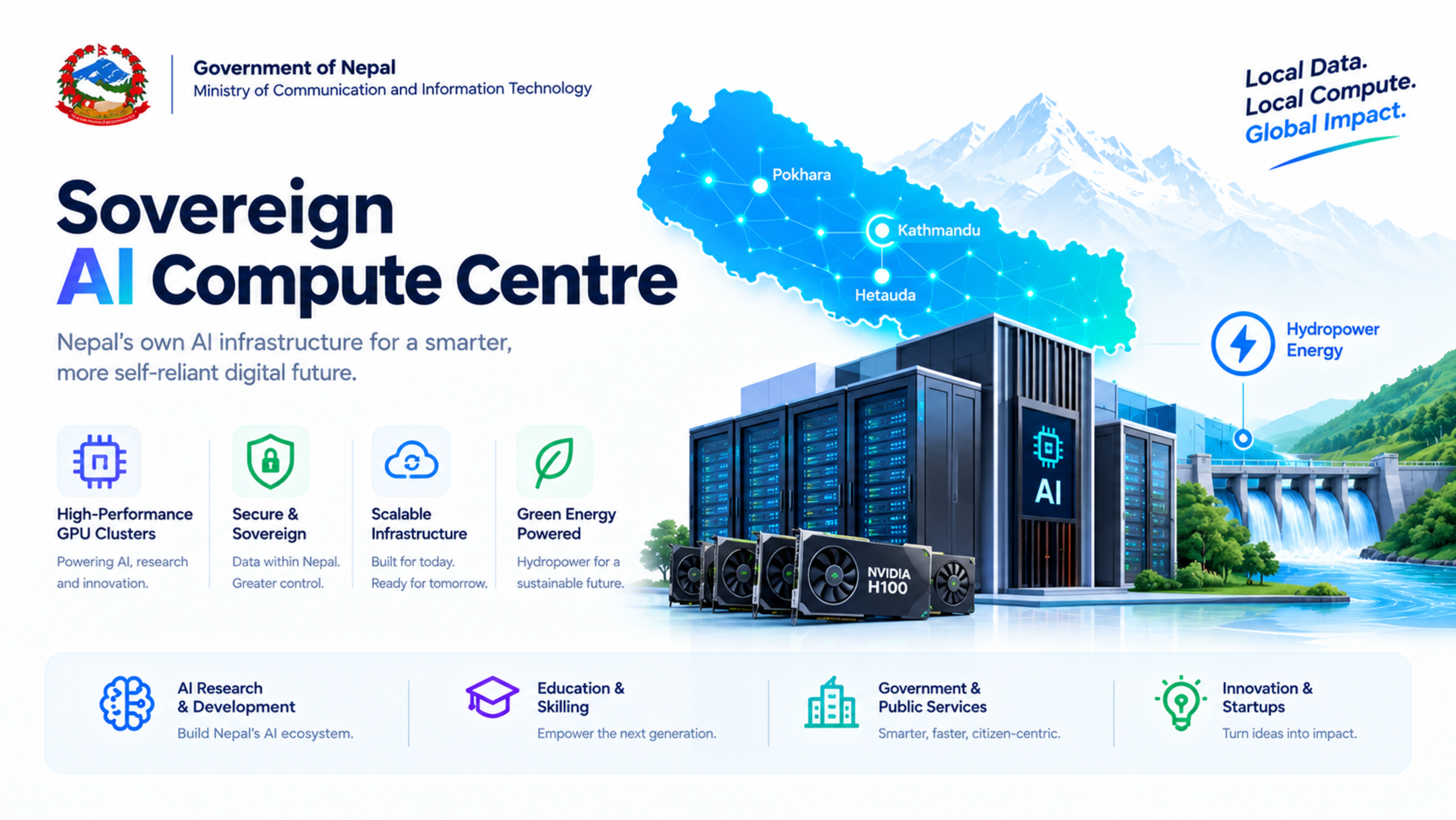
Nepal has announced plans to establish its first Sovereign AI Compute Centre in Syuchatar, Kathmandu. The initiative aims to give Nepali startups, researchers, and entrepreneurs access to high-performance AI computing capacity at subsidized rates, while positioning Nepal’s hydropower resources as a foundation for digital exports.
The announcement was made in the federal budget for fiscal year 2083/84 by Finance Minister Dr. Swarnim Wagle. The government plans to procure thousands of AI processing units and provide concessional computing capacity to AI entrepreneurs and startups.
What is a Sovereign AI Compute Centre?
A sovereign AI compute centre is a national AI infrastructure facility designed to provide computing power within a country’s own jurisdiction. It can support AI model training, inference, data processing, application hosting, and research workloads.
In Nepal’s case, the proposed centre would use the country’s clean hydropower capacity to operate thousands of AI processing units. The goal is to offer affordable high-performance computing to domestic startups and entrepreneurs instead of requiring every business to rely entirely on foreign cloud platforms.
Why AI compute capacity matters
AI applications need significant computing power, especially for training and running machine-learning models. This computing power is usually delivered through GPUs, specialized AI processors, cloud infrastructure, and high-speed storage systems.
For many Nepali startups, accessing this infrastructure can be expensive. A sovereign AI compute centre could reduce that barrier by offering subsidized or concessional compute capacity.
What businesses could use it for
Local businesses and startups could use AI compute capacity for:
Training or fine-tuning AI models
Running AI chatbots and customer-support assistants
Building recommendation systems
Processing Nepali-language text, speech, or image data
Developing computer-vision applications
Running predictive analytics
Hosting AI-powered SaaS products
Automating document processing and business workflows
Supporting research and data-science projects
What Nepal’s plan includes
According to the budget announcement, the government plans to:
Establish Nepal’s first Sovereign AI Compute Centre in Syuchatar, Kathmandu
Purchase thousands of AI processing units
Provide concessional computing capacity to AI entrepreneurs and startups
Use Nepal’s hydropower resources to support high-value AI computing services
Support digital exports, skilled employment, and a knowledge-based economy.
The plan positions AI infrastructure as part of a broader national effort to move Nepal toward a knowledge-based economy.
Why hydropower matters for AI
AI data centres consume large amounts of electricity. Nepal’s hydropower potential could become an advantage if the country can convert reliable clean energy into dependable computing services.
The government’s stated vision is to turn hydropower into high-value AI compute services, creating skilled employment and supporting digital exports.
This could be important for Nepal because it links two national strengths:
Clean energy generation
A growing technology and outsourcing workforce
If implemented well, it could help Nepal compete not only on cost but also on sustainable AI infrastructure.
What it means for Nepali startups
For startups, the biggest potential benefit is lower access to expensive AI infrastructure.
A startup building an AI product may no longer need to invest heavily in GPUs, servers, cooling, networking, and data-centre operations. Instead, it could access subsidised compute capacity and focus more on product development, customer acquisition, and innovation.
Opportunities for startups
Nepali startups could use the centre to build:
AI-powered customer-support platforms
Nepali-language chatbots and voice assistants
Document-processing and OCR systems
Agricultural prediction tools
Healthcare diagnostics and record-analysis tools
Education and learning platforms
Fintech fraud-detection systems
Logistics and route-optimisation tools
Tourism and travel recommendation platforms
Local-language content and media tools
What it means for software companies
For software companies, the announcement could create demand for services beyond basic website development.
Companies may need help with:
AI application development
API integration
Cloud architecture
Data pipelines
Model deployment
MLOps and monitoring
Cybersecurity
DevOps automation
SaaS product development
Data privacy and compliance
A business may have access to AI compute capacity, but it still needs the right software architecture, data strategy, and engineering team to turn that capacity into a useful product.
What it means for developers
The initiative could increase demand for AI-related technical skills in Nepal, including:
Python and machine-learning frameworks
TensorFlow, PyTorch, and Hugging Face tools
API development
Cloud and GPU infrastructure
Docker and Kubernetes
MLOps
Data engineering
Cybersecurity
Vector databases
Retrieval-augmented generation, or RAG
AI agent development
Model evaluation and monitoring
Developers who combine software engineering with AI deployment skills may be better positioned for future opportunities in Nepal’s growing digital economy.
Data sovereignty and privacy
A sovereign AI compute centre could also help Nepal keep sensitive data within its own jurisdiction. This is important for government services, healthcare, finance, education, and businesses handling customer information.
However, infrastructure alone does not guarantee privacy. Nepal will also need strong data-governance practices, transparent policies, secure access controls, and clear rules for how AI systems use personal and business data.
For businesses, the key question will be: Where is my data stored, who can access it, and how is it protected?
Challenges Nepal must address
The plan is ambitious, and its success will depend on execution.
Infrastructure reliability
AI data centres need stable electricity, cooling, networking, redundancy, and physical security. Nepal must ensure that hydropower capacity translates into reliable, uninterrupted computing services.
Talent availability
Building infrastructure is only part of the challenge. Nepal also needs AI engineers, data scientists, MLOps specialists, cybersecurity professionals, and product teams capable of using the infrastructure effectively.
Governance and transparency
The government will need clear rules for pricing, access, data ownership, security standards, service-level agreements, and fair allocation of computing resources.
Commercial viability
The centre must offer services that startups and enterprises actually need at a price they can afford. It should also maintain competitive performance, uptime, and support standards.
Private-sector participation
Collaboration with ISPs, cloud providers, universities, startups, and global technology companies could help accelerate adoption and create a stronger ecosystem.
How businesses should prepare
Nepali businesses do not need to wait for the centre to become fully operational. They can prepare now by identifying practical AI use cases.
1. Identify repetitive processes
Look for tasks that consume staff time, such as responding to common enquiries, processing documents, preparing reports, qualifying leads, or managing appointments.
2. Improve data quality
AI systems need clean, organised, and accessible data. Businesses should begin organising customer records, product data, service information, and internal documents.
3. Start with a small AI workflow
Instead of trying to automate everything, begin with one high-value workflow such as lead follow-up, FAQ support, invoice reminders, or report generation.
4. Build secure foundations
Review website security, access controls, backups, API security, and data privacy before adding AI systems.
5. Work with the right technical partner
AI adoption requires more than access to compute power. Businesses need a partner that understands product strategy, software architecture, data security, and long-term maintenance.
What this means for Nepal’s digital economy
If implemented effectively, the Sovereign AI Compute Centre could help Nepal move from being primarily an outsourcing destination to building and exporting higher-value AI products and services.
Nepal’s technology sector is already expanding across software development, AI services, remote work, cloud-driven development, and international outsourcing. A national AI compute facility could strengthen that ecosystem by giving local startups and researchers better access to the infrastructure needed to build globally competitive products.
Official and related sources
Nepal News: Nepal’s AI Compute Center plan draws scrutiny over feasibility and risks
RatoPati: Nepal Aims for Knowledge-Based Economy with AI Focus
Nepal News: Everything You Need to Know About Nepal’s Budget for FY 2026/27
TechSansar: Nepal Budget 2083/84 Tech, IT, Innovation Reference
Business 360: TSN Hosts AI Summit Nepal 2026 and Unveils NAIDC
Frequently Asked Questions
What is Nepal’s Sovereign AI Compute Centre?
It is Nepal’s proposed first national AI computing facility, planned for Syuchatar, Kathmandu. It aims to provide high-performance AI computing capacity to Nepali startups, researchers, and entrepreneurs at concessional rates.
Where will Nepal’s AI compute Centre be built?
The government has announced Syuchatar, Kathmandu, as the location for Nepal’s first Sovereign AI Compute Centre.
Who can use the AI compute Centre?
The government has said the Centre will provide subsidized computing capacity to AI entrepreneurs, startups, and researchers.
Why is Nepal using hydropower for AI computing?
AI data center's require significant electricity. Nepal’s clean hydropower resources could provide a competitive advantage for running AI infrastructure and developing high-value digital export services.
What does this mean for Nepali startups?
Startups may gain cheaper access to AI computing resources, making it easier to build AI products, train models, process data, and launch technology-based services.
Will the AI compute Centre improve data privacy?
It could support data sovereignty by keeping computing and data processing within Nepal’s jurisdiction. However, strong data-governance rules, security controls, and transparent policies will still be essential.
When will the Centre be operational?
The government has announced the plan, but a confirmed public launch date and full operational details have not yet been clearly published. Businesses should follow official budget and SDOC-related announcements for updates.
AI Solutions, Chatbots & Workflow Automation
Custom LLM integrations, WhatsApp AI chatbots, automated data extraction, CRM sync, and workflow automations that replace manual busywork.
Feedback & Discussion
Have questions or insights? Share your thoughts below.