
Nepal’s Digital Public Infrastructure Push Creates Opportunities for Software Companies
Nepal’s Digital Public Infrastructure Push Creates Opportunities for Software Companies
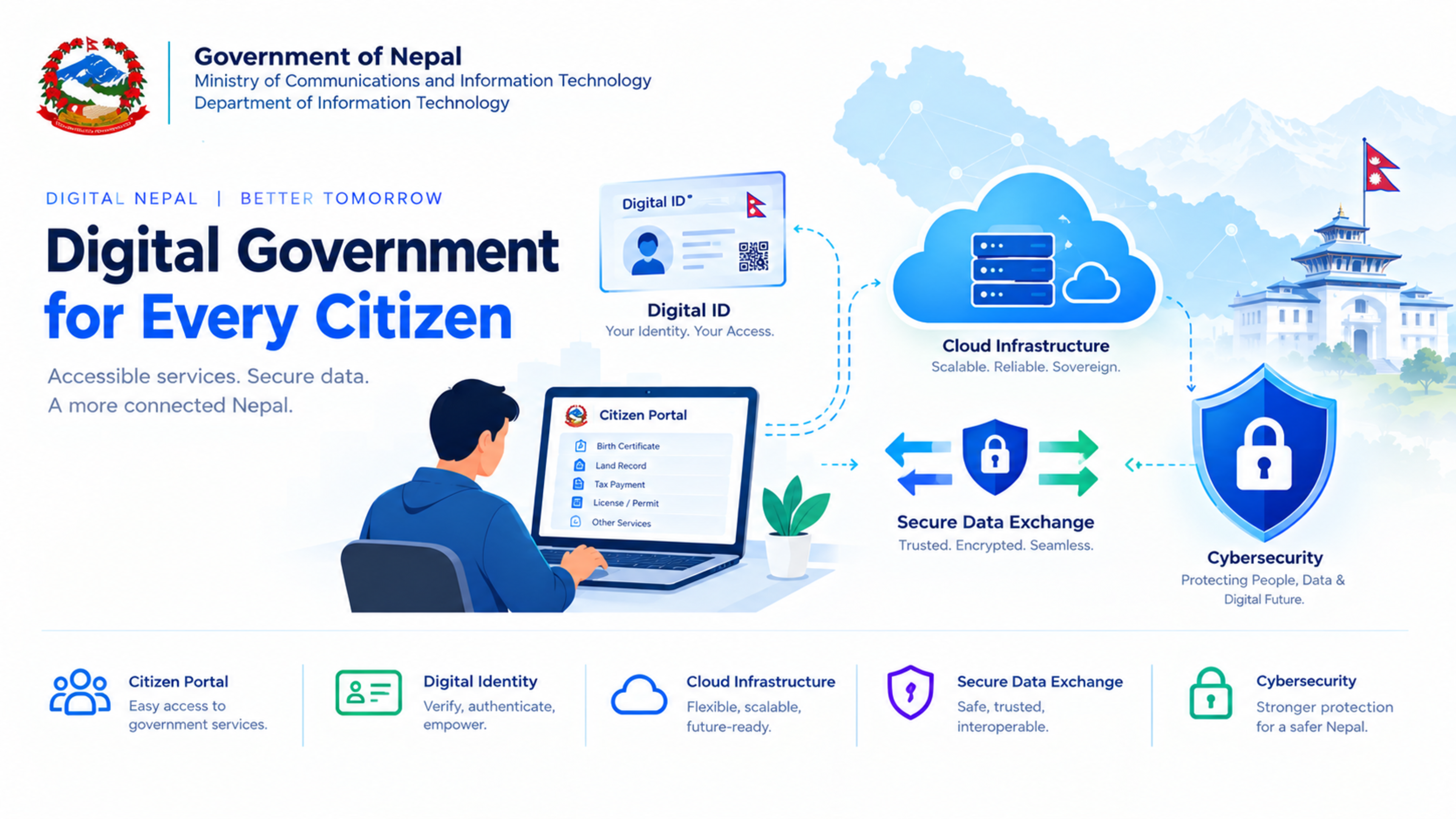
Nepal is moving toward a stronger digital government ecosystem through the Nepal Digital Transformation Project, a major initiative to build Digital Public Infrastructure, or DPI. The project will support integrated citizen services, secure data exchange, digital identity, digital wallets, cybersecurity, and data governance.worldbank+1
For software companies, startups, developers, and IT service providers, this creates opportunities beyond traditional website development. Nepal’s public sector will need secure platforms, interoperable systems, cloud infrastructure, data integration, user-friendly design, and long-term technical support.worldbank+1
What is Digital Public Infrastructure?
Digital Public Infrastructure refers to the shared digital systems that allow citizens, businesses, and government agencies to access and deliver services securely online.
In Nepal, this includes:
Digital identity systems
Integrated citizen service portals
Secure government-wide data exchange
Digital lockers for verifiable credentials
Digital wallets
Social registries
Cybersecurity systems
Data-governance frameworksworldbank+1
The goal is to reduce paper-based processes and make public services faster, more transparent, and easier to access.
What the Nepal Digital Transformation Project includes
The World Bank-approved project will invest in several core digital platforms and services.
Integrated citizen service portal
The project plans to support an integrated online citizen service portal. This could allow citizens to access multiple government services through one digital platform instead of visiting separate offices or navigating disconnected department websites.worldbank+1
Nagarik App expansion
The project will help individuals and businesses transact through the Nagarik app, an integrated online and mobile service portal.documents1.worldbank+1
This could make it easier for citizens to access services such as registrations, certificates, payments, and government-related information from one place.
Secure data exchange
A major part of the project is a secure government-wide data-exchange framework. This will help different ministries and agencies share information securely and interoperably.worldbank+1
Secure data exchange is essential for reducing duplicate paperwork, improving service accuracy, and enabling digital services to work across departments.
Digital locker and digital wallet
The project will also invest in a digital locker for verifiable credentials and a digital wallet.
A digital locker could allow citizens to store and share documents securely, while a digital wallet could support digital transactions and service payments.
Cybersecurity and data governance
The project will invest in electronic signatures, cybersecurity, and data governance to build trust in Nepal’s digital economy.
This is important because digital public services handle sensitive personal information, identity data, financial records, and government documents.
Why this matters for software companies
Nepal’s DPI push creates demand for companies that can build, integrate, secure, and maintain digital systems.
1. Government platform development
Software companies can support the development of:
Citizen service portals
Mobile applications
Admin dashboards
Public-facing web platforms
Workflow automation systems
Document-management systems
Payment and service-delivery platforms
2. System integration
Government services often involve multiple departments, databases, and legacy systems. Software companies can help connect these systems through secure APIs, data pipelines, and interoperability standards.
3. Cloud and DevOps services
Digital public infrastructure needs reliable hosting, monitoring, backups, deployment pipelines, and scalable infrastructure. This creates demand for cloud architecture, DevOps, containerisation, and infrastructure automation.
4. Cybersecurity services
As more services move online, security becomes critical. Software companies can support secure coding, vulnerability assessment, access control, encryption, monitoring, and incident-response planning.
5. UI/UX and accessibility
Government platforms must be easy to use for citizens with different levels of digital literacy. This creates demand for user research, accessible design, multilingual interfaces, mobile-first design, and usability testing.
6. Data engineering and AI
Secure data exchange can create opportunities for data engineering, analytics, reporting, and responsible AI applications. However, these systems must be built with privacy, consent, and data governance in mind.
Opportunities for Nepali startups
Startups can participate in the digital ecosystem by building tools and services that work alongside public infrastructure.
Possible opportunities include:
Digital document verification tools
Identity verification services
Ecommerce and payment integrations
Logistics and delivery platforms
Health-tech and education platforms
Agricultural data services
Financial inclusion tools
Local-language accessibility tools
Customer-support automation
Business compliance and registration tools
The project also aims to encourage private-sector investment in Nepal’s data-infrastructure market by improving legal and regulatory frameworks.
What skills will be in demand?
The DPI push could increase demand for professionals with skills in:
Full-stack web development
React and Next.js
Node.js and backend APIs
Laravel and PHP maintenance
Cloud architecture
DevOps and CI/CD
Cybersecurity
Database administration
API development
UI/UX design
Data engineering
Quality assurance
Product management
Digital accessibility
Nepal’s government has also declared IT a national strategic industry and plans to promote software, digital services, cloud, cybersecurity, green computing, and AI computation exports.
Challenges to address
Digital transformation is not only about building apps. Nepal must also solve long-term operational challenges.
Interoperability
Different government departments may use different systems, data formats, and processes. A successful DPI ecosystem needs shared standards and secure integration.
Data privacy
Citizens must trust that their personal information is protected. Strong consent, access control, encryption, audit trails, and data-governance policies are essential.
Cybersecurity
Public platforms are high-value targets for attackers. Security must be built into systems from the beginning, not added after launch.
Digital inclusion
Services must work for people with limited digital skills, slower internet connections, and different language needs.
Sustainability
Government platforms require ongoing maintenance, monitoring, updates, support teams, and funding. A one-time development project is not enough.
What businesses should do now
Businesses that want to participate in Nepal’s digital economy should prepare in three areas.
1. Build secure, scalable products
Use secure coding practices, strong authentication, encrypted data storage, role-based access, and reliable backups.
2. Focus on interoperability
Design systems with APIs, clear data structures, and integration-ready architecture. This makes it easier to connect with future public or private platforms.
3. Improve user experience
Build simple, mobile-friendly, accessible interfaces. A government service is only useful if citizens can actually use it easily.
How Global IT Services can help
Global IT Services helps businesses and organisations build secure, scalable digital platforms through web development, custom software, Next.js applications, cloud-ready architecture, UI/UX design, and AI automation.
For companies preparing to work with Nepal’s growing digital ecosystem, the best starting point is a strong technical foundation: secure architecture, clean data structure, reliable integrations, and a user-focused interface.
Frequently Asked Questions
What is Digital Public Infrastructure in Nepal?
Digital Public Infrastructure refers to shared digital systems that enable secure online public services, including digital identity, citizen portals, data exchange, digital lockers, digital wallets, cybersecurity, and data governance.
What is the Nepal Digital Transformation Project?
It is a World Bank-supported project designed to strengthen Nepal’s digital public infrastructure and digitise high-impact public services.
What is the Nagarik app?
The Nagarik app is an integrated online and mobile portal that allows citizens and businesses to access government-related digital services.
How can software companies benefit from Nepal’s DPI push?
Software companies can provide platform development, system integration, cloud architecture, cybersecurity, UI/UX design, data engineering, and long-term maintenance services.worldbank+1
Why is cybersecurity important for digital government?
Digital government systems handle sensitive citizen and business data. Cybersecurity helps protect that data from breaches, misuse, fraud, and service disruption.
Will DPI create IT jobs in Nepal?
Yes. The project is expected to support job creation in ICT services, digital platforms, and downstream service industries as digital adoption increases.
Feedback & Discussion
Have questions or insights? Share your thoughts below.