
Lok Sewa Computer Engineer Syllabus 2083/84: What to Study and How to Prepare
Lok Sewa Computer Engineer Syllabus 2083/84: What to Study and How to Prepare
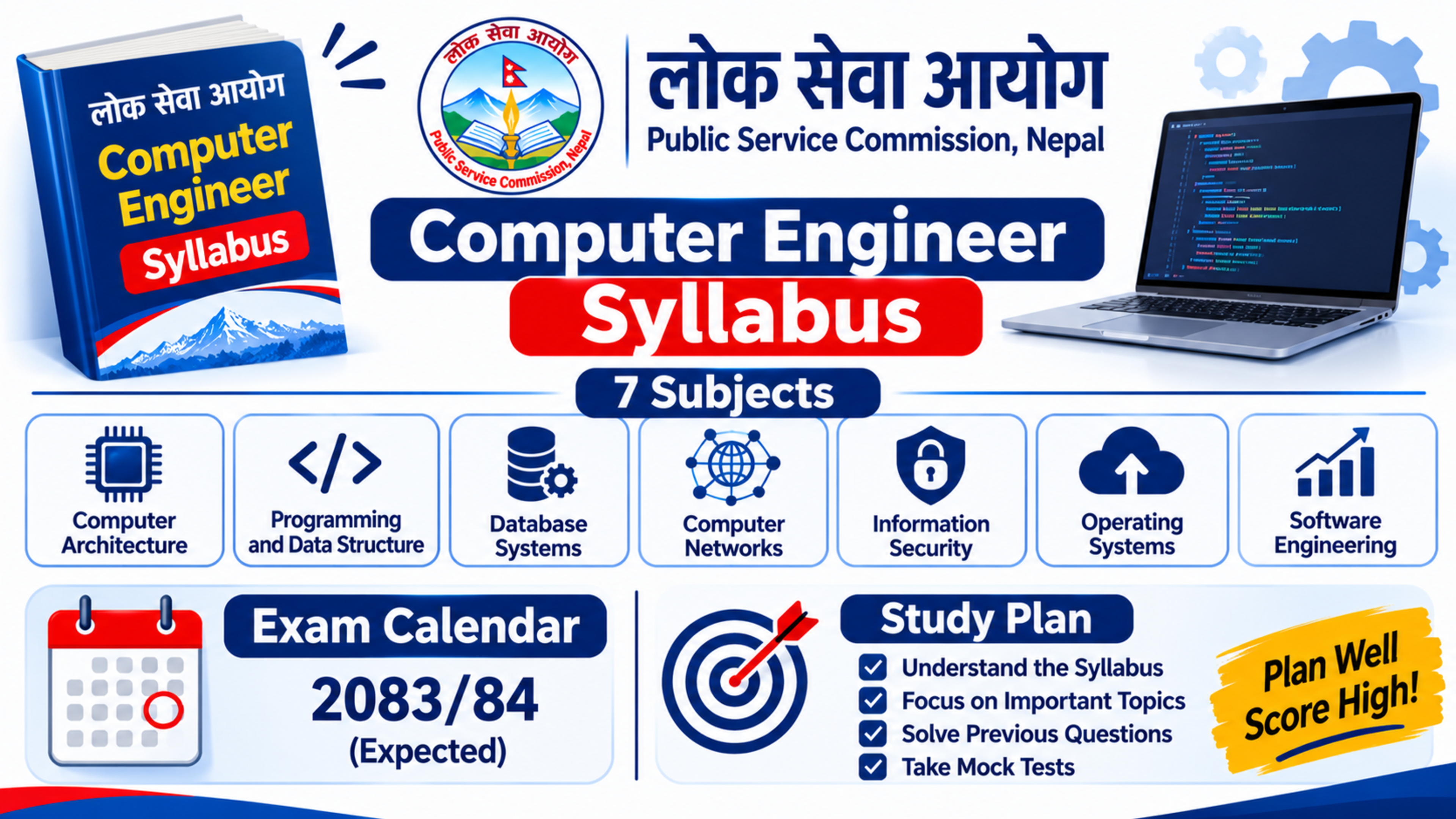
The Lok Sewa Computer Engineer syllabus 2083/84 covers seven major subject areas, ranging from computer fundamentals and networking to software engineering, databases, operating systems, and advanced topics like AI and cryptography. Understanding the full syllabus is the first step to scoring well in the Gazetted Third Class exam.
This guide breaks down every section of the syllabus, explains the exam pattern, and gives you a practical study plan to prepare effectively.
Exam pattern overview
The Lok Sewa Computer Engineer exam consists of two written papers, each of which tests different aspects of your knowledge.
Paper | Focus | Duration |
|---|---|---|
First Paper | General subjects + technical fundamentals | As per PSC schedule |
Second Paper | Advanced technical subjects | As per PSC schedule |
The exam is conducted at 2:00 PM on the scheduled dates (2083/12/03 for first paper, 2083/12/04 for second paper for Computer Engineer).
The 7 major subject areas
The Computer Engineer syllabus is divided into 7 major sections:
Computer Fundamentals
Networking
Computer Architecture and Organisation
Programming and Data Structures
Software Engineering and Databases
Operating Systems
Advanced Topics (AI, Theory of Computation, Compiler, Graphics, Security)
Let’s break down each one.
1. Computer Fundamentals
This section covers the basics of computing.
Topics include
Generation of Computers
Components and Architecture of Computers
Connecting the Components
Getting started: Orientation to personal computers, system unit, starting the computer
Input Devices: keyboard, mouse
Study tips
Focus on computer history and generations
Understand basic hardware components
Know input/output devices
Practice identifying computer parts
2. Networking
Networking is a major section with significant weight.
Topics include
Protocol Stack and Switching
Link Layer: Ethernet, ARP, CSMA/CD, Wireless LAN and PPP
Network Layer: IP Addressing, Routing, RIP, OSPF and IPv6
Transport Layer: UDP, TCP, Flow and Congestion Control
Application Layer: Web, FTP, Email, DNS and Socket Programmingloksewaonline
Study tips
Memorise the OSI and TCP/IP models
Understand IP addressing and subnetting
Know routing protocols (RIP, OSPF)
Understand TCP vs UDP differences
Practice DNS, FTP, and email protocols
3. Computer Architecture and Organisation
This section covers how computers work at the hardware level.
Topics include
Sequential Circuits, State Table and Architecture
Von Neumann, Harvard, RISC and CISC
Data Representation, Arithmetic, Bus and Instruction Cycle
Addressing Modes, I/O, Interrupt, DMA and Memory Systems
808x Intel Microprocessor Programming and Interfacing
Digital Number Systems, Logic Gates and Combinational Circuits
Sequential Logic, Counters, Registers and IC Families
Electrical Circuits: AC, Transformers, Filters and Transients
Semiconductor Diodes, Transistors, Amplifiers and Op-Amp
Electronic Communication: Modulation, Error Control, SNR and BERloksewaonline
Study tips
Understand Von Neumann vs Harvard architecture
Know RISC vs CISC differences
Practice number system conversions (binary, octal, hex)
Understand logic gates and Boolean algebra
Know basic electronics (diodes, transistors, op-amps)
4. Programming and Data Structures
This section tests your programming and algorithm knowledge.
Topics include
Structured Programming: Data Types, Operators and Control Structures
Functions, Procedures and Modular Programming
Object Oriented Programming: Class, Encapsulation, Inheritance and Polymorphism
Patterns, Frameworks and Object Composition
ADT, Complexity, Big O, Theta, Best, Average and Worst Case
Linear Data Structures: Stack, Queue and Linked List
Trees: BST, AVL, Red-Black, Splay and Traversals
Algorithm Design: Greedy, Divide and Conquer, Dynamic Programming and Recursionloksewaonline
Study tips
Master C/C++ or Java fundamentals
Understand OOP concepts (encapsulation, inheritance, polymorphism)
Practice Big O notation and complexity analysis
Implement common data structures (stack, queue, linked list, tree)
Solve algorithm problems (sorting, searching, dynamic programming)
5. Software Engineering and Databases
This section covers software development and database management.
Topics include
Software Design, Implementation, Testing and Maintenance
Formal Methods, ISO, CMM, CASE and Process Improvement
Relational Model, ER Model, SQL, Normalization and File Structure
Transaction, Concurrency, Crash Recovery, Query Optimization and Indexing
Distributed Database, Data Mining, Warehousing and Securityloksewaonline
Study tips
Understand SDLC (Software Development Life Cycle)
Know software testing types (unit, integration, system)
Master SQL and database normalisation
Understand ACID properties and transactions
Know indexing and query optimisation
6. Operating Systems
This section covers how operating systems work.
Topics include
Processes, Threads, Synchronization, Scheduling and Deadlock
Memory Management, I/O, File System and Distributed OS Securityloksewaonline
Study tips
Understand process vs thread
Know scheduling algorithms (FCFS, SJF, Round Robin)
Understand deadlock conditions and prevention
Know memory management (paging, segmentation)
Understand file systems and I/O
7. Advanced Topics
This section covers advanced and specialised topics.
Topics include
Artificial Intelligence: Search, NLP, Game, Learning, Reasoning, Planning, Vision and Robotics
Theory of Computation: Grammar, DFA, NFA, Regular Expression and Pumping Lemma
CFG, PDA, Turing Machine, Chomsky Hierarchy, Undecidability and P-NP
Compiler Structure, Lexical Analysis, Parsing and Syntax Directed Translation
Type Checking, Runtime Storage, Intermediate Code and Optimization
Computer Graphics: Raster Algorithms, Transformations, Viewing, Projection and Rendering
Parallel Distributed Computing, High Speed Networks and Software Architecture
Cryptography, Network Security, E-Commerce, Embedded, Multimedia, GIS and GPSloksewaonline
Study tips
Understand basic AI concepts (search, learning, reasoning)
Know automata theory basics (DFA, NFA, regular expressions)
Understand compiler phases (lexical, parsing, code generation)
Know basic cryptography (symmetric, asymmetric, hashing)
Understand network security fundamentals
Study plan: 8-week preparation
Here’s a practical 8-week study plan to cover the entire syllabus.
Week | Focus | Key topics |
|---|---|---|
1 | Computer Fundamentals + Architecture | Generations, components, number systems, logic gates |
2 | Computer Architecture continued | Microprocessor, memory, I/O, interrupts |
3 | Networking Part 1 | OSI/TCP-IP models, Ethernet, ARP, IP addressing |
4 | Networking Part 2 | Routing, TCP/UDP, application layer protocols |
5 | Programming + Data Structures | OOP, complexity, stacks, queues, trees, algorithms |
6 | Software Engineering + Databases | SDLC, testing, SQL, normalisation, transactions |
7 | Operating Systems + Advanced Topics Part 1 | Processes, threads, scheduling, AI, theory of computation |
8 | Advanced Topics Part 2 + Revision | Compilers, graphics, cryptography, full revision |
Preparation tips
1. Focus on high-weightage topics
Networking, Computer Architecture, and Programming/Data Structures tend to carry more weight. Prioritise these.
2. Practice previous year questions
Solve previous year question papers to understand the exam pattern and question types.
3. Use standard textbooks
Refer to standard textbooks like:
Computer Networks by Tanenbaum
Operating System Concepts by Silberschatz
Introduction to Algorithms by CLRS
Database System Concepts by Korth
Software Engineering by Pressman
4. Take mock tests
Practice full-length mock tests under exam conditions to build speed and accuracy.
5. Revise regularly
Set aside time each week to revise previously covered topics. Spaced repetition is key to retention.
Common mistakes to avoid
Ignoring less “interesting” topics like theory of computation or compiler design
Not practising enough numerical problems (subnetting, number systems)
Cramming at the last minute
Not solving previous year questions
Neglecting the general subjects (Nepali, English, GK) in the first paper
Frequently Asked Questions
What are the 7 major sections of the Lok Sewa Computer Engineer syllabus?
The 7 major sections are: Computer Fundamentals, Networking, Computer Architecture and Organisation, Programming and Data Structures, Software Engineering and Databases, Operating Systems, and Advanced Topics.
How many papers are there in the Computer Engineer exam?
There are two written papers: First Paper and Second Paper, both conducted at 2:00 PM.
When are the Computer Engineer exams in 2083/84?
The first paper is on 2083/12/03 and the second paper is on 2083/12/04.
Which topics carry the most weight?
Networking, Computer Architecture, and Programming/Data Structures tend to carry more weight based on the syllabus structure.loksewaonline
How long should I prepare?
A focused 8-week study plan is usually sufficient if you study consistently for 3-4 hours daily.
Can Software Engineering graduates apply for Computer Engineer?
Not automatically. Software Engineering is not listed among the accepted qualifications for Computer Engineer. You may need formal academic equivalence.
Feedback & Discussion
Have questions or insights? Share your thoughts below.