
Google Confirms Core Update: What Website Owners Should Check First
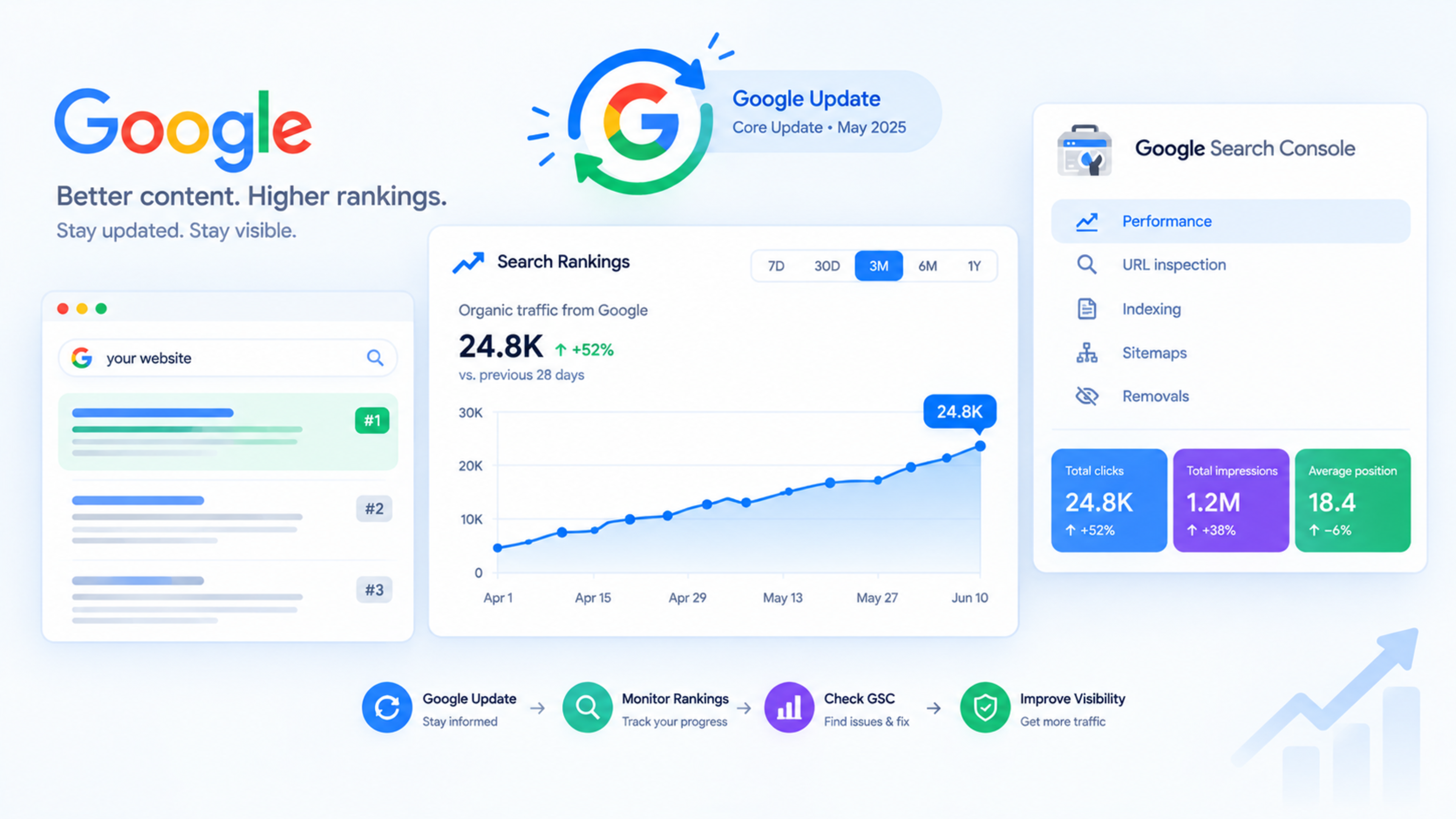
Google Confirms Core Update: What Website Owners Should Check First
Google has confirmed a core update, which can cause noticeable changes in search rankings across many industries. If your website’s traffic, impressions, or keyword positions have changed, the first step is not to panic or make random changes—it is to identify what actually changed.
Core updates are broad improvements to Google’s search systems. They are not penalties, and they do not target one type of website. However, they can reshuffle results when Google’s systems become better at assessing relevance, quality, and helpfulness.developers.google+1
What is a Google core update?
A Google core update is a significant change to Google’s search ranking systems. Unlike a small spam filter or a specific feature update, a core update can affect how Google evaluates content quality, relevance, and overall search experience across many queries.
Google announces these updates through its official channels, including the Google Search Status Dashboard, which shows confirmed updates and rollout status. Checking this dashboard helps you separate a confirmed Google update from a technical issue on your own website.
What should you check first?
If your rankings or traffic changed during a core update, start with evidence—not assumptions.
1. Check Google Search Console
Open Google Search Console and compare performance before and after the update period.
Look at:
Total clicks
Total impressions
Average position
Queries bringing traffic
Pages losing or gaining visibility
Indexing status
Mobile usability and security issues
A drop in impressions may mean Google is showing your pages less often. A drop in clicks with stable impressions may mean your pages are appearing but attracting fewer clicks.
2. Identify which pages changed
Do not only look at total website traffic. Break the data down by landing page, query, device, and country.
Ask:
Did one service page lose visibility, or did the whole site decline?
Did blog content lose rankings while service pages remained stable?
Did mobile performance change more than desktop?
Did branded searches decline, or only non-branded keywords?
Did a competitor clearly move above you for important queries?
This helps you understand whether the issue is site-wide, page-specific, or query-specific.
3. Review technical SEO basics
Core updates can expose weaknesses that already existed. Check that Google can properly crawl, render, and index your important pages.
Review:
XML sitemap accuracy
Robots.txt rules
Canonical tags
Redirect chains
Broken internal links
Orphan pages
Duplicate or thin content
Mobile usability
HTTPS and security warnings
Core Web Vitals
If important pages are not indexed, no content improvement will help until Google can access and understand them.
4. Assess content helpfulness
Google’s guidance focuses on helpful, reliable, people-first content. After a core update, review whether your pages genuinely answer the searcher’s question better than competing pages.developers.google
For each important page, check:
Does the page answer the main question quickly?
Does it include original insight, examples, or experience?
Is the content accurate and up to date?
Does it match the search intent?
Is it easy to read on mobile?
Does it include useful headings, FAQs, tables, or checklists?
Does it demonstrate real expertise?
Does it link to relevant supporting pages?
Avoid rewriting every article immediately. First identify which pages lost visibility and whether they truly deserve to rank for their target query.
5. Review E-E-A-T signals
Core updates often place more attention on content quality and trust. Review whether your website clearly shows who is behind the content and why they are qualified to write it.developers.google
Check:
Author names and bios
Author photos and professional profiles
Relevant experience
Accurate credentials
Contact information
About and team pages
Case studies and client results
Reviews and testimonials
Consistent business information across the web
Google has also updated its guidance around deceptive authorship, including fake bylines and AI-generated author headshots. Use real authors, accurate bios, and verifiable professional profiles rather than invented identities.
Official Google resources to use
Use these official Google resources before relying on third-party speculation:
Google Search Status Dashboard — Check confirmed updates and rollout status.
Google Search Console — Review performance, indexing, security, and mobile usability.
Google Search Central Blog — Read official announcements and guidance.
Creating Helpful, Reliable, People-First Content — Use Google’s self-assessment questions to review content quality.
Google Search Central Documentation — Review technical SEO, crawling, indexing, structured data, and spam policy guidance.
Google Search Quality Rater Guidelines — Understand how Google explains quality, E-E-A-T, and helpful content to its quality raters.
These sources will not give you a secret ranking formula, but they help you align your website with Google’s published guidance.
What not to do after a core update
Avoid these common mistakes:
Deleting pages immediately after a traffic drop
Changing titles, URLs, and content across the whole website at once
Buying backlinks or using risky link schemes
Adding fake author profiles or AI-generated headshots
Publishing thin AI-generated articles to replace lost traffic
Blaming the update before checking technical issues
Making major changes during the update rollout
Ignoring Search Console data and relying only on third-party rank trackers
A core update is not a signal to rebuild your entire SEO strategy overnight. It is a signal to review quality, relevance, technical health, and user experience carefully.
How long does recovery take?
There is no fixed recovery timeline. Some websites see movement while the update is still rolling out. Others need weeks or months to recover, especially if the update revealed deeper content or authority issues.
Google has previously explained that sites affected by core updates may need to wait for a future update if they want to see improvement. The practical approach is to improve the website based on evidence, then measure changes over time.developers.google
What to do if traffic dropped
Follow this simple process:
Confirm the update and its rollout period.
Compare Search Console data before and after the update.
Identify affected pages, queries, and devices.
Check technical SEO and indexing.
Review content quality and search intent.
Improve author, brand, and trust signals.
Make focused improvements—not mass changes.
Monitor performance for several weeks.
Repeat the review after the next confirmed update.
How Global IT Services can help
Global IT Services helps businesses review ranking changes through technical SEO audits, Google Search Console analysis, content quality reviews, and AI-search readiness improvements.
If your website lost traffic after a Google core update, we can help identify whether the issue is technical, content-related, authority-related, or a combination of all three.
Frequently Asked Questions
What is a Google core update?
A Google core update is a broad change to Google’s search ranking systems. It can affect how Google evaluates content relevance, quality, and helpfulness across many websites and search queries.
Is a Google core update a penalty?
No. A core update is not a manual penalty. It is a broad ranking-system change. However, websites with weak content, poor technical health, or low trust signals may see visibility decline.
How do I know if my website was affected by a core update?
Compare Google Search Console performance data before, during, and after the update period. Look for changes in clicks, impressions, average position, affected pages, and search queries.
How long should I wait after a Google core update?
Wait until the update rollout is complete before making major decisions. Then monitor performance for several weeks. Avoid making large-scale changes based on short-term ranking movements.
Can a website recover from a core update?
Yes. Websites can improve by strengthening content quality, technical SEO, user experience, author trust, brand signals, and topical relevance. Recovery takes time and should be based on evidence from Search Console and a proper audit.
Technical SEO & Global Growth Marketing
End-to-end search engine optimization, programmatic SEO, technical audits, and content strategy for businesses targeting local and international markets.
Feedback & Discussion
Have questions or insights? Share your thoughts below.