
How Much Does It Cost to Build a SaaS Product in 2026?
Learn how much it costs to build a SaaS product in 2026. Compare MVP, growth-stage, and enterprise SaaS costs, including design, development, cloud, and maintenance.
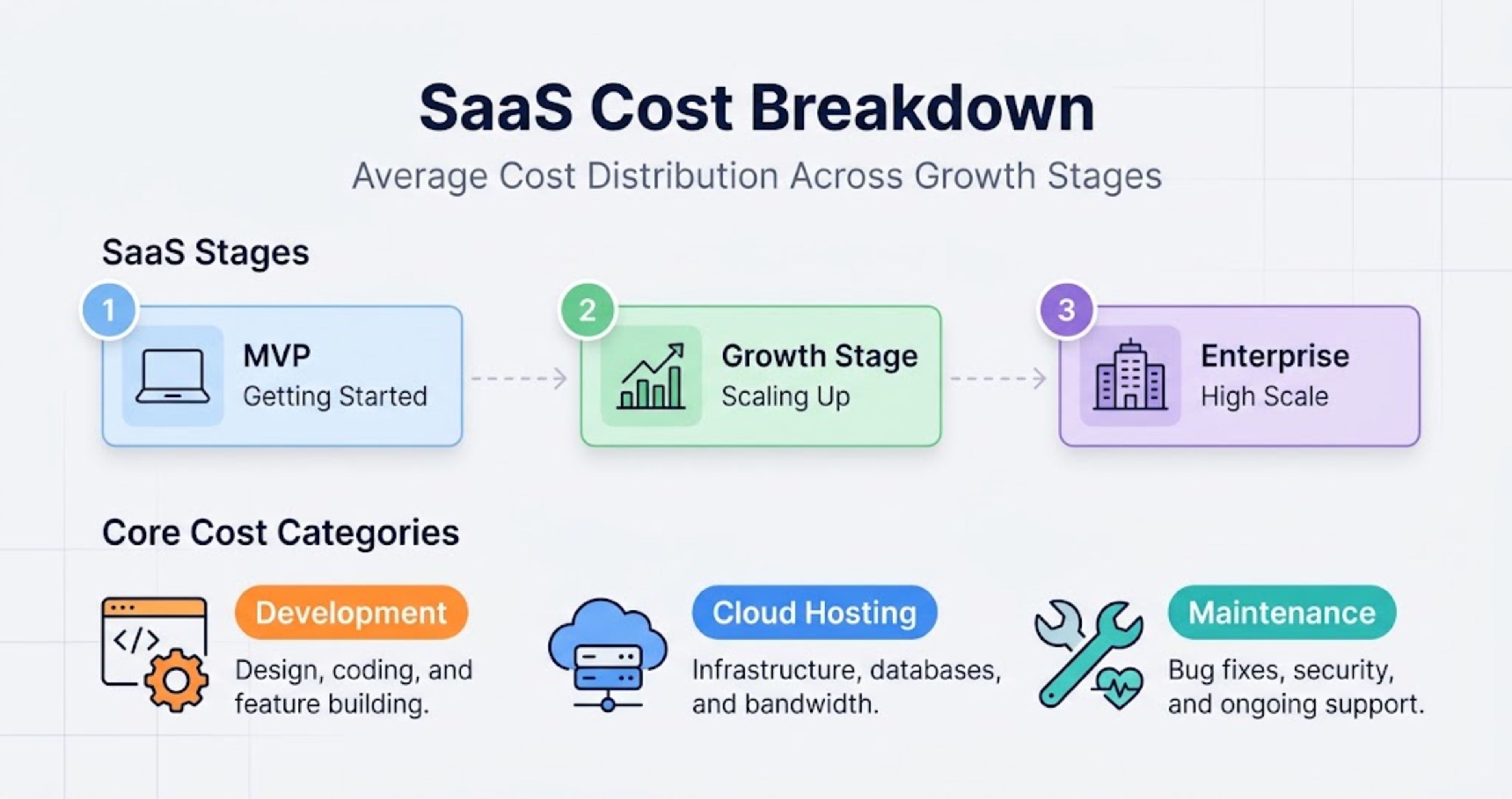
How Much Does It Cost to Build a SaaS Product in 2026?
The cost to build a SaaS product in 2026 can range from a few thousand dollars for a simple MVP to hundreds of thousands of dollars for a complex enterprise platform. The final cost depends on features, user roles, integrations, design, security, cloud infrastructure, and ongoing maintenance.
A basic SaaS MVP may cost around NPR 800,000 to NPR 3,000,000 or roughly USD 6,000 to USD 22,000, depending on the team and scope. A growth-stage SaaS product can cost significantly more, while enterprise-grade platforms with compliance, integrations, and advanced security can cost much higher.
This guide explains what affects SaaS development cost, what a realistic budget should include, and how to avoid overspending before you have validated demand.
What is a SaaS product?
SaaS stands for Software as a Service. It is software that users access through the internet, usually through a web browser or mobile app, rather than installing it on their own computers.
Examples include:
CRM platforms
Project-management tools
Accounting software
Booking systems
Learning platforms
HR and payroll systems
Marketing automation tools
Ecommerce management platforms
AI-powered business tools
A SaaS product usually includes user accounts, subscriptions, a dashboard, data storage, role-based access, and ongoing updates.
SaaS development cost: Quick overview
SaaS stage | Typical cost range | Typical timeline | Main goal |
|---|---|---|---|
Simple SaaS MVP | NPR 800,000–3,000,000 | 8–16 weeks | Validate the core idea |
Standard SaaS product | NPR 3,000,000–10,000,000 | 4–8 months | Launch a complete product |
Growth-stage SaaS | NPR 10,000,000–30,000,000+ | 6–12 months or more | Scale users, features, and integrations |
Enterprise SaaS | NPR 30,000,000+ | 9–18 months or more | Security, compliance, and complex workflows |
These figures are indicative. The actual cost depends on the complexity of the product, the experience of the team, the number of integrations, and the level of security required.
What affects SaaS development cost?
1. Product complexity
A simple SaaS product with one main workflow costs much less than a platform with multiple user roles, advanced reporting, integrations, and automation.
For example, a simple booking SaaS may only need:
Customer registration
Service listing
Calendar booking
Payment
Email confirmation
Basic admin dashboard
A complex CRM SaaS may need:
Multiple user roles
Lead pipelines
Team collaboration
Custom fields
Reporting
API access
Role-based permissions
Audit logs
Advanced integrations
The second product requires much more planning, development, and testing.
2. Number of user roles
Each user role adds design, permissions, and testing work.
Common SaaS roles include:
Super admin
Organisation admin
Manager
Team member
Customer
Viewer
Billing admin
Support agent
A product with three or four roles costs less than a platform with complex permission levels and organisation-based access.
3. Design requirements
A functional MVP can use a clean, simple interface. A customer-facing SaaS product that needs strong branding, onboarding, animations, and polished dashboards will cost more.
Design work may include:
User research
Wireframes
Design system
Dashboard design
Mobile-responsive layouts
Onboarding flow
Accessibility improvements
Branding and visual identity
4. Integrations
Integrations often increase both cost and timeline.
Common SaaS integrations include:
Stripe, PayPal, or local payment gateways
Google Calendar
Outlook Calendar
Slack
Microsoft Teams
Mailchimp or other email platforms
CRM systems
Accounting tools
Cloud storage
SMS providers
WhatsApp Business API
AI providers
Analytics platforms
Each integration requires development, testing, error handling, and maintenance.
5. Security and compliance
Security is essential for SaaS products because they store user data and often handle payments.
Security work may include:
Secure authentication
Two-factor authentication
Role-based access control
Data encryption
Secure API design
Audit logs
Regular backups
Vulnerability scanning
Compliance documentation
Penetration testing
Products handling healthcare, finance, education, or government data may require stricter security and compliance work.
6. Cloud infrastructure
SaaS products need hosting, databases, storage, monitoring, backups, and deployment systems.
Cloud costs depend on:
Number of users
Data storage
Traffic
Background jobs
AI or GPU usage
Database size
CDN usage
Backup frequency
Support level
A small SaaS product may have low cloud costs at first, but costs can increase as usage grows.
7. Ongoing maintenance
SaaS is not a one-time project. After launch, you need ongoing support for:
Bug fixes
Security updates
Server and cloud maintenance
Dependency updates
Feature improvements
Customer support
Performance monitoring
Database optimisation
Backup management
A good rule is to plan for continuous product improvement, not just initial development.
SaaS MVP cost breakdown
An MVP should include only the features needed to validate the core idea.
A typical SaaS MVP may include:
Landing page
User registration and login
Basic dashboard
One core workflow
Subscription or one-time payment
Email notifications
Basic admin panel
Analytics setup
Basic security
For example, a booking SaaS MVP may allow customers to book appointments, pay online, and receive email confirmations. It may not need team management, advanced reporting, mobile apps, or complex integrations in the first version.
Example: Booking SaaS MVP
A clinic wants a simple booking platform.
The MVP may include:
Clinic profile
Service list
Appointment calendar
Customer registration
Booking form
Payment integration
Email confirmation
Basic admin dashboard
This focused scope can be developed faster and at a lower cost than a full clinic-management platform.
Growth-stage SaaS cost
After the MVP is validated, businesses usually add features based on user feedback.
A growth-stage SaaS product may include:
Team collaboration
Advanced roles and permissions
Reporting dashboards
API access
Third-party integrations
Improved onboarding
Customer-support tools
Billing management
Subscription upgrades
Advanced security
Performance optimisation
At this stage, the product is no longer just an MVP. It needs a stronger architecture, better testing, and a long-term maintenance plan.
Enterprise SaaS cost
Enterprise SaaS products cost more because they often require:
Complex permissions
Multi-tenant architecture
Advanced security
Compliance requirements
Custom integrations
High availability
Audit trails
Data isolation
Dedicated support
Scalable infrastructure
Detailed documentation
Examples include healthcare platforms, financial systems, large HR platforms, logistics systems, and enterprise CRM tools.
Development team cost
The cost also depends on who builds the product.
Team type | Cost pattern | Best for |
|---|---|---|
Freelancer | Lower cost, limited capacity | Very small MVPs |
Small agency | Balanced cost and structure | Startups and SMBs |
Full-service agency | Higher cost, broader skills | Product strategy, design, development, SEO |
In-house team | Higher long-term cost | Long-term product ownership |
Dedicated offshore team | Flexible scaling | Ongoing product development |
A freelancer may be suitable for a very small MVP. A product team is usually better when the SaaS needs design, frontend, backend, QA, DevOps, and ongoing support.
Hidden SaaS costs to plan for
Many founders budget only for development and forget ongoing costs.
Domain and branding
Domain name
Logo and brand identity
Brand guidelines
Marketing website
Cloud and software costs
Cloud hosting
Database hosting
File storage
CDN
Email service
Monitoring tools
Error tracking
Payment gateway fees
AI API costs
Maintenance and support
Bug fixes
Security patches
Dependency updates
Server maintenance
Customer support
Feature requests
Performance improvements
Marketing and growth
SEO content
Paid ads
Analytics tools
Conversion optimisation
Sales tools
Customer onboarding
A SaaS product needs a growth budget, not only a development budget.
How to reduce SaaS development cost
1. Start with an MVP
Do not build every feature before launch. Focus on the core workflow that proves your idea.
2. Use a clear feature list
Create three lists:
Must-have
Should-have
Later
This prevents scope creep and unexpected costs.
3. Avoid complex features early
Delay advanced features such as mobile apps, AI recommendations, multi-language support, complex reporting, and enterprise integrations until demand is proven.
4. Use proven technology
Choose a technology stack your team can maintain. Next.js is often a strong choice for SaaS products that need public marketing pages, SEO, authentication, dashboards, and API routes.
5. Use subscription billing carefully
Start with one payment provider and one or two pricing plans. Add more pricing complexity only when customers need it.
6. Plan for maintenance
Set aside a monthly budget for updates, monitoring, security, and improvements. This prevents technical debt from becoming expensive later.
Example SaaS budget
Here is an example budget for a simple SaaS MVP:
Item | Estimated cost |
|---|---|
Discovery and planning | NPR 100,000–250,000 |
UI/UX design | NPR 150,000–500,000 |
Frontend development | NPR 250,000–800,000 |
Backend development | NPR 250,000–900,000 |
Payment integration | NPR 50,000–200,000 |
Testing and QA | NPR 100,000–300,000 |
Deployment and cloud setup | NPR 50,000–200,000 |
Project management | NPR 100,000–300,000 |
Estimated total | NPR 1,050,000–3,450,000 |
The final cost may be lower or higher depending on scope, team rates, and product complexity.
How to choose a SaaS development partner
Before hiring a development team, check:
Relevant SaaS or product experience
UI/UX capability
Backend and cloud expertise
Security knowledge
Testing process
Communication process
Source-code ownership
Maintenance terms
Client references
Clear project milestones
For a broader hiring process, read our guide on how to hire a software development company in Nepal.
Common SaaS development mistakes
Avoid these mistakes:
Building too many features before validating demand
Ignoring user onboarding
Underestimating cloud and maintenance costs
Choosing technology based only on trends
Skipping security planning
Not planning for scalability
Launching without analytics
Ignoring customer feedback
Treating SaaS as a one-time development project
How Global IT Services can help
Global IT Services helps startups and businesses plan, design, develop, and maintain SaaS products, MVPs, customer portals, dashboards, and AI-powered platforms.
If you are planning a SaaS product, start with a focused MVP, validate demand, and invest in features based on real user feedback.
Frequently Asked Questions
How much does it cost to build a SaaS product?
A simple SaaS MVP can cost around NPR 800,000 to NPR 3,000,000. A standard SaaS product may cost NPR 3,000,000 to NPR 10,000,000, while enterprise SaaS platforms can cost much more.
How long does it take to build a SaaS product?
A SaaS MVP usually takes 8 to 16 weeks. A complete SaaS product can take four to eight months or longer, depending on features and complexity.
What is the cheapest way to build a SaaS product?
Start with a focused MVP, use a proven technology stack, avoid unnecessary integrations, and launch with only the core workflow needed to validate demand.
Does SaaS development include hosting costs?
Not always. Development cost and cloud hosting cost are usually separate. You should budget for hosting, database, storage, email, monitoring, backups, and third-party services.
Can I build a SaaS product with Next.js?
Yes. Next.js is a strong choice for SaaS products that need public marketing pages, SEO, authentication, dashboards, API routes, and scalable web architecture.
What is the difference between SaaS MVP and full SaaS product?
An MVP includes only the core features needed to validate the idea. A full SaaS product includes advanced features, integrations, security, scalability, and a complete user experience.
Fullstack Web & App Development
High-performance, scalable web platforms engineered for global reach and conversions.
Explore this service
Feedback & Discussion
Have questions or insights? Share your thoughts below.