
MVP vs Full Product: What Should Startups Build First?
Learn the difference between an MVP and a full product. Compare cost, timeline, risks, features, and when startups should build an MVP first.
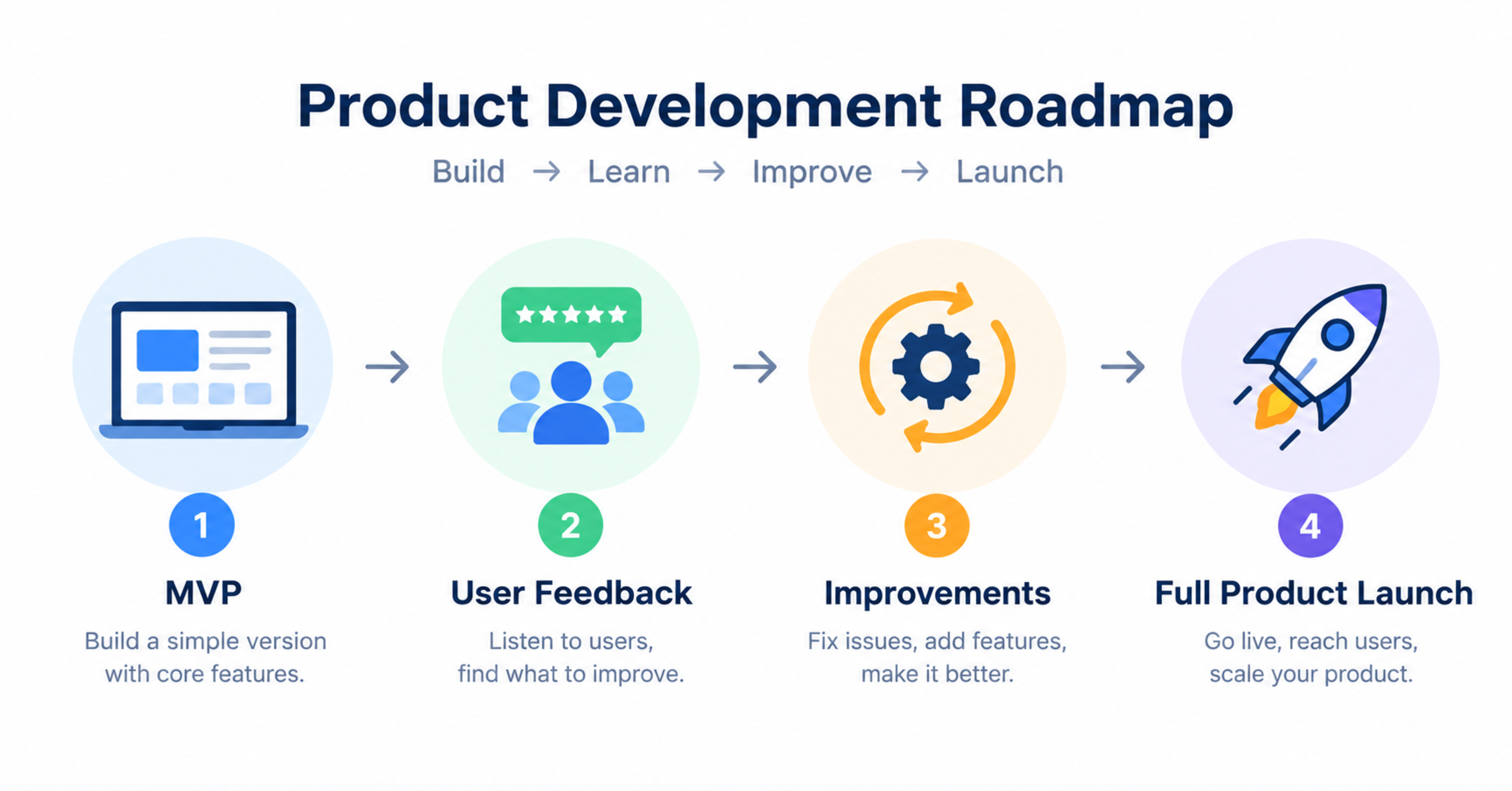
MVP vs Full Product: What Should Startups Build First?
Most startups should build an MVP first. An MVP, or minimum viable product, includes only the core features needed to test whether people actually want your solution. A full product includes the complete feature set, polished design, integrations, and scalability needed for long-term growth.
Choosing between an MVP vs full product is not only a technical decision. It is a business decision about risk, budget, customer feedback, and speed to market.
Building every feature before launch can take months and cost more than necessary. Building an MVP first allows you to test the main idea, learn from real users, and invest in features that customers actually need.
What is an MVP?
An MVP is the first usable version of a product. It solves one main problem for one specific group of users.
The word “minimum” does not mean low quality. It means focused. An MVP should be reliable, useful, and simple enough to test the core idea.
For example, if you are building a food-delivery platform, your MVP may only need:
Customer registration
Restaurant listings
Menu browsing
Cart and checkout
Order placement
Basic delivery status
It may not need loyalty points, advanced analytics, driver apps, multi-city support, AI recommendations, or complex reporting in the first version.
What is a full product?
A full product is a complete version of the software with the features, design quality, integrations, and scalability needed for a wider market.
A full food-delivery product might include:
Customer, restaurant, and delivery-partner apps
Advanced search and filters
Live order tracking
Multiple payment gateways
Ratings and reviews
Loyalty programmers
Coupons and promotions
Admin dashboards
Analytics and reporting
Multi-city support
Customer-support tools
Automated notifications
Fraud prevention
Scalable cloud infrastructure
A full product is appropriate when the business model has been validated and there is clear demand for the additional features.
MVP vs full product: Quick comparison
Factor | MVP | Full product |
|---|---|---|
Main goal | Validate the idea | Scale a proven product |
Features | Core features only | Complete feature set |
Timeline | Weeks to a few months | Several months or longer |
Cost | Lower initial investment | Higher upfront investment |
Design | Simple, usable, focused | Polished, scalable, brand-focused |
User feedback | Early and frequent | Based on a larger user base |
Risk | Lower if scoped properly | Higher if demand is unproven |
Best for | Startups and new ideas | Validated products and growing businesses |
Changes | Easier to adjust | More planning and development required |
Why startups should start with an MVP
1. You test the real idea faster
Many startup ideas fail not because the technology is weak, but because the market does not need the product in the way the founder imagined.
An MVP helps you test whether customers will use the product, pay for it, and return to it.
2. You reduce initial cost
A full product can require significant investment in design, development, testing, infrastructure, and support. An MVP reduces the initial scope and allows you to spend money on learning what works.
3. You get real user feedback
Real users behave differently from assumptions. They may use one feature heavily, ignore another, or ask for something you did not expect.
Early feedback helps you improve the product based on evidence.
4. You can launch sooner
A focused MVP can often be launched in weeks or a few months. This gives you time to attract early users, test marketing channels, and refine the product before competitors enter the space.
5. You avoid building unused features
Many products include features that customers rarely use. An MVP helps you avoid spending money on features before you know whether they matter.
What an MVP should include
An MVP should include only the features needed to solve the main problem.
Use this simple filter:
Does this feature solve the core problem?
Can users complete the main goal without it?
Can it be added later without affecting the core product?
Does it directly support validation or revenue?
If the answer is “no,” it probably belongs in a later version.
Example: Fitness coaching platform
A fitness coach wants to build an online coaching platform.
A full product might include:
Workout builder
Diet planner
Video library
Progress tracking
Chat and video calls
Payment subscriptions
Mobile apps
Trainer marketplace
AI workout recommendations
An MVP might include only:
Coach profile
Client registration
Workout plan delivery
Progress tracking
Payment for a coaching plan
Basic messaging
This is enough to test whether clients will pay for online coaching and use the platform regularly.
What an MVP should not include
Do not include features that do not help validate the core idea.
Avoid starting with:
Complex admin panels
Advanced reporting
Multi-language support
Mobile apps for every platform
AI recommendations
Complex loyalty programmers
Multiple payment gateways
Extensive user roles
Marketplace features
Custom integrations
Advanced design animations
These features can be valuable later, but they should not delay validation.
MVP vs prototype
An MVP and a prototype are different.
Item | Prototype | MVP |
|---|---|---|
Purpose | Test design and flow | Test real demand and usability |
Users | Usually internal or test users | Real customers |
Functionality | Often clickable but limited | Working core features |
Data | Often sample data | Real data and transactions |
Goal | Learn how the product should look | Learn whether the product should exist |
A prototype can come before an MVP. It helps test the user journey before investing in full development.
How to plan an MVP
1. Define the problem clearly
Write down the exact problem you are solving.
Instead of saying, “I want to build a business management app,” say:
“Small service businesses need a simple way to track enquiries, assign follow-ups, and see which leads are pending.”
2. Identify the target user
Define who will use the product first.
For example:
Local restaurants
Clinics
Coaching businesses
Real-estate agents
Ecommerce sellers
Educational institutions
Service-based startups
A narrower audience makes it easier to build a focused MVP.
3. Define the core action
Identify the one action that proves the product works.
Examples:
Customer places an order
Client books an appointment
User completes a workout plan
Business owner tracks a lead
Student completes a lesson
Customer makes a payment
4. List features in three groups
Create three lists:
Must-have: Required for the core workflow
Should-have: Useful, but not required for launch
Later: Valuable, but should wait until after validation
This prevents scope creep.
5. Choose the right technology
Choose technology based on the product’s needs, not trends.
For many MVPs, Next.js is a strong choice because it can support:
Fast public-facing pages
SEO-friendly landing pages
User authentication
Dashboard features
API routes
Payment integration
Scalable architecture
For a private dashboard-only MVP, React may be enough. For a SaaS product with public marketing pages and an application, Next.js is often more practical.
6. Launch, measure, and improve
After launch, track real user behavior. Use analytics, feedback forms, support requests, and customer interviews to decide what to build next.
How much does an MVP cost?
MVP cost depends on features, design, platform, integrations, and team location.
MVP type | Typical cost range | Typical timeline |
|---|---|---|
Simple web MVP | NPR 300,000–900,000 | 4–8 weeks |
Marketplace MVP | NPR 800,000–2,500,000 | 8–16 weeks |
SaaS MVP | NPR 800,000–3,000,000+ | 8–16 weeks |
Mobile-app MVP | NPR 700,000–2,500,000+ | 8–16 weeks |
Complex platform MVP | NPR 2,000,000+ | 4–9 months or more |
These are indicative ranges. A clear feature list and discovery phase are more important than estimating based only on a general category.
Common MVP mistakes
Avoid these mistakes:
Building too many features before launch
Calling an unfinished product an MVP
Ignoring design and usability
Not defining the core user action
Building for every user type at once
Skipping testing
Not collecting feedback
Launching without analytics
Changing direction too frequently
Treating the MVP as the final product
An MVP should be small, but it should still be complete enough to provide a real experience.
When to build a full product first
In some cases, a full product may be appropriate from the beginning.
Consider a full product if:
You already have validated demand.
You are replacing an established internal system.
You have a clear enterprise requirement.
Security, compliance, or integration needs are complex.
You have funding and a proven business model.
You are building for a market where a basic version cannot compete.
Even then, break the project into phases. A full product should still be developed through milestones, testing, and user feedback.
MVP roadmap example
A practical SaaS roadmap could look like this:
Phase 1: MVP
Landing page
User registration
Core dashboard
One main workflow
Basic payment
Email notifications
Phase 2: Improvement
User feedback implementation
Better onboarding
Additional reports
Improved UI/UX
More integrations
Performance optimization
Phase 3: Growth
Advanced roles and permissions
Team collaboration
Mobile app or PWA
AI-powered features
Analytics dashboard
Enterprise integrations
Phase 4: Scale
Multi-region support
Advanced security
API marketplace
Partner integrations
Enterprise features
Automated customer support
This approach allows the product to grow based on evidence rather than assumptions.
How Global IT Services can help
Global IT Services helps startups and businesses plan, design, and build MVPs, SaaS products, customer portals, dashboards, ecommerce platforms, and AI-powered applications.
If you have a product idea, the best first step is to define the core problem, identify the main user action, and build only what is needed to validate demand.
Frequently Asked Questions
What is an MVP in product development?
An MVP, or minimum viable product, is the first version of a product with only the core features needed to solve a main problem and test demand with real users.
What is the difference between an MVP and a full product?
An MVP focuses on validating the core idea with limited features. A full product includes the complete feature set, polished design, integrations, and scalability needed for long-term growth.
Why should startups build an MVP first?
Startups should build an MVP first to reduce cost, launch faster, test real demand, collect user feedback, and avoid investing in features customers may not need.
How much does it cost to build an MVP?
MVP cost depends on features, design, platform, and integrations. A simple web MVP may cost a few lakh rupees, while a SaaS, marketplace, or mobile-app MVP can cost significantly more.
How long does it take to build an MVP?
A simple MVP can take four to eight weeks. A SaaS, marketplace, or mobile-app MVP may take eight to sixteen weeks or longer, depending on complexity.
Can an MVP make money?
Yes. An MVP can generate revenue if it solves a real problem and includes a clear payment or subscription model. Many startups charge from the first version if the core value is strong.
Should an MVP have good design?
Yes. An MVP should be simple, but it should still be usable, clear, and professional. Poor design can prevent users from understanding or trusting the product.
Fullstack Web & App Development
High-performance, scalable web platforms engineered for global reach and conversions.
Explore this service
Feedback & Discussion
Have questions or insights? Share your thoughts below.