
Local SEO for UK Service Businesses: A Practical 2026 Guide
Learn how local SEO helps UK service businesses get more local enquiries. This guide covers Google Business Profile, local keywords, reviews, citations, and location pages.
Local SEO for UK Service Businesses: A Practical 2026 Guide
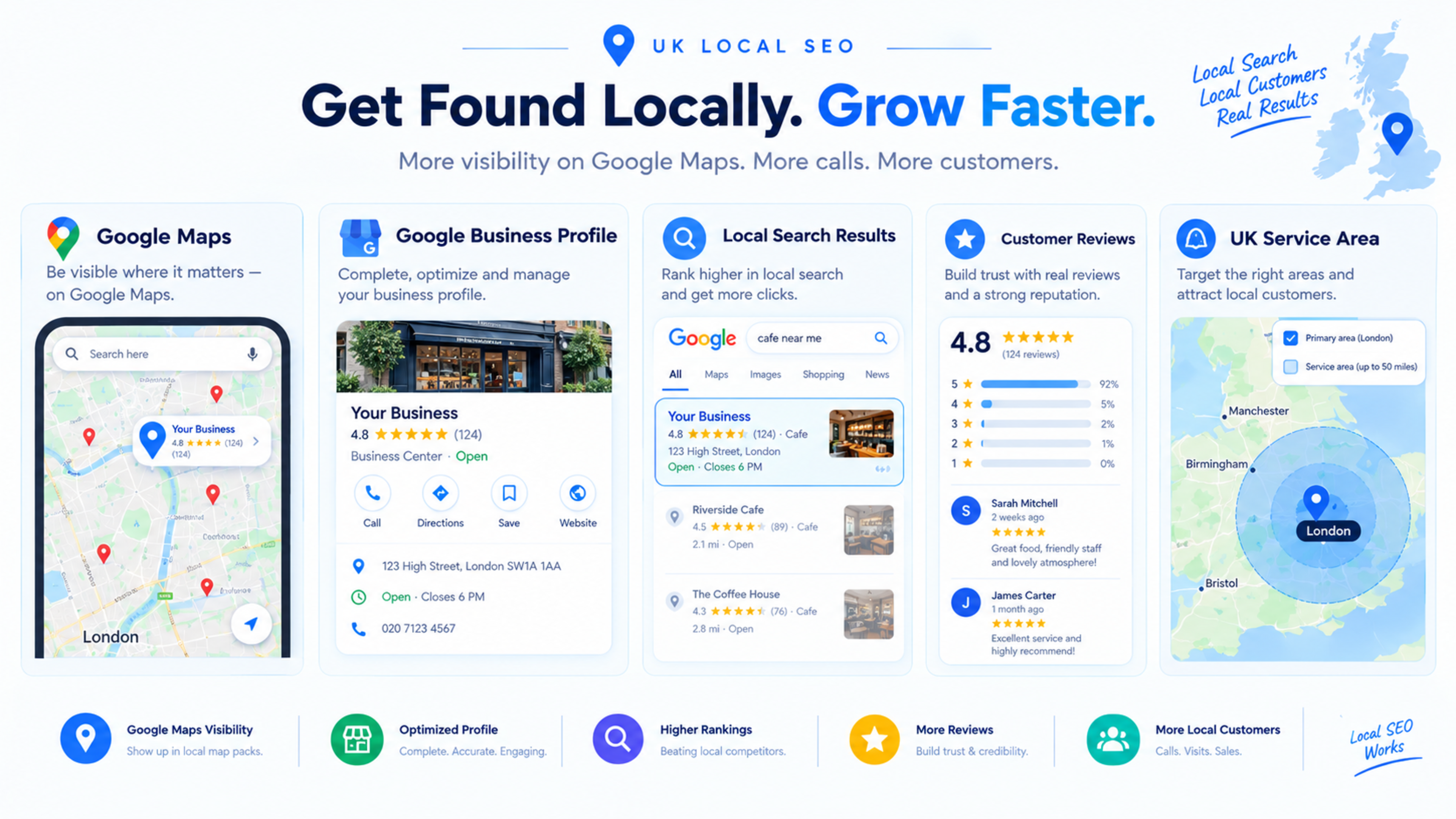
Local SEO helps UK service businesses appear when nearby customers search for services such as “plumber near me,” “dentist in Manchester,” or “SEO agency London.” It focuses on Google Business Profile, local keywords, reviews, citations, location pages, and consistent business information.
If your business serves customers in a specific town, city, or region, local SEO can bring more qualified enquiries than broad national keywords. Someone searching for an emergency plumber in Leeds is usually much closer to making a decision than someone searching for general plumbing advice.
This guide explains how local SEO works in the UK and the practical steps service businesses should take to improve local visibility.
What is local SEO?
Local SEO is the process of improving your visibility in location-based search results. It helps your business appear in:
Google Search results
Google Maps
Google’s local pack
“Near me” searches
City or town-based searches
Mobile local searches
For example, if someone searches for “emergency electrician in Birmingham,” Google aims to show relevant businesses near that location.
Local SEO is especially important for businesses such as:
Plumbers
Electricians
Builders
Dentists
Solicitors
Accountants
Salons
Clinics
Gyms
Restaurants
Cleaning companies
Driving instructors
IT support providers
Why local SEO matters for UK businesses
Many local searches lead directly to calls, bookings, or enquiries. A customer searching for a nearby service often has immediate intent, especially on mobile.
Local SEO matters because it helps you:
Appear in Google Maps and local search results
Attract nearby customers
Generate phone calls and bookings
Build trust through reviews
Compete with larger businesses in your area
Reduce dependence on paid advertising
Improve visibility for service-area searches
Google Business Profile, consistent business information, reviews, and local content remain important signals for local visibility.profiletree+1
Local SEO vs national SEO
Local SEO and national SEO have different goals.
Factor | Local SEO | National SEO |
|---|---|---|
Target area | A town, city, region, or service area | The whole UK |
Main focus | Google Business Profile and local relevance | Content, authority, and broader keyword coverage |
Main keywords | “Plumber in Leeds” | “Best CRM software UK” |
Main platforms | Google Maps and local search | Google organic search |
Best for | Local service businesses | Ecommerce, SaaS, and national brands |
Key signals | Proximity, reviews, GBP, local citations | Content, backlinks, technical SEO, brand authority |
A local business may need both. For example, a dental clinic in Manchester may need local SEO for nearby patients and national SEO for informational dental content.
Step 1: Set up Google Business Profile
Your Google Business Profile is one of the most important local SEO assets. It controls how your business appears on Google Search and Google Maps.
Create or claim your profile at Google Business Profile.
Make sure you complete:
Business name
Address or service area
Phone number
Website
Business hours
Business categories
Services
Service areas
Photos
Business description
Booking or contact links
Use your real business name. Do not add keywords or location names to your business name unless they are part of your official trading name.
Step 2: Choose the right business categories
Your primary category should describe your main service.
For example:
Plumber
Electrician
Dentist
Accountant
Solicitor
Web designer
Marketing agency
Hair salon
Physiotherapist
Then add relevant secondary categories only if they genuinely match your services.
Do not choose unrelated categories just to appear in more searches. Accurate categories help Google understand your business.
Step 3: Add services and service areas
Add every service you want to be found for.
For example, a web development company may add:
Website design
Web development
Next.js development
Ecommerce website development
Technical SEO
Website maintenance
A plumber may add:
Emergency plumbing
Boiler repair
Bathroom installation
Leak detection
Central heating repair
Also define your service areas. If you serve customers across a city or region, list those areas clearly.
Step 4: Keep your business information consistent
Consistency is a major local SEO signal. Your business name, address, and phone number—often called NAP—should be the same everywhere online.
Use the same details on:
Your website
Google Business Profile
Facebook
LinkedIn
Local directories
Industry directories
Invoices
Email signatures
Inconsistent information can confuse both customers and search engines.
UK local SEO guidance recommends using identical wording for business name, services, and location across your website and directory listings.profiletree
Step 5: Create location pages
If you serve multiple towns or cities, create dedicated location pages.
For example:
/plumbers-london//plumbers-manchester//plumbers-birmingham/
Each page should include:
The service you provide
The area you serve
Local customer questions
Service areas covered
Testimonials from that area, if available
Local contact details
Clear call to action
Do not create dozens of near-identical pages with only the city name changed. Each location page should include genuinely useful local information.
Step 6: Create service pages
A location page tells customers where you work. A service page explains what you do.
For example, a web development company may create:
/services/web-development//services/nextjs-development//services/technical-seo//services/ecommerce-development/
A plumber may create:
/services/boiler-repair//services/emergency-plumbing//services/bathroom-installation/
Then connect service pages and location pages with internal links.
Example:
Link from
/plumbers-manchester/to/services/boiler-repair/Link from
/services/boiler-repair/to/plumbers-manchester/
This helps Google understand both your services and service areas.
Step 7: Use local keywords naturally
Use the keywords your local customers actually search for.
Examples include:
“Emergency plumber in Leeds”
“Dentist in Manchester”
“SEO agency London”
“Web designer Birmingham”
“Accountant near me”
“Boiler repair Bristol”
Use these phrases naturally in:
Page titles
Meta descriptions
H1 and H2 headings
Service descriptions
Location pages
FAQs
Image alt text
Do not repeat the same phrase unnaturally. Write for people first.
Step 8: Collect and respond to reviews
Reviews are one of the strongest trust signals for local businesses. They help customers decide whether to contact you and can support your visibility in local search.
Ask happy customers to leave a review after completing a job, appointment, or project.
Make it easy by:
Sending a direct review link
Asking soon after a positive experience
Explaining how long it takes
Avoiding fake or incentivised reviews
Respond to reviews professionally, including negative ones. A calm, helpful response shows potential customers that you take feedback seriously.
Step 9: Build local citations
A local citation is any online mention of your business name, address, and phone number.
Common citation sources include:
Yell
Yelp
Thomson Local
Scoot
FreeIndex
Local chambers of commerce
Industry directories
Local news websites
Business associations
Before submitting your business, check whether the directory is relevant and reputable. Consistency matters more than the number of citations.
Step 10: Add local schema markup
Schema markup helps search engines understand your business details.
For local service businesses, use:
LocalBusinessProfessionalServiceDentist,Plumber, or another relevant specific type where availableServiceReviewAggregateRatingFAQPageBreadcrumbList
Include accurate details such as:
Business name
Address
Phone number
Website
Opening hours
Service areas
Reviews, only if genuine
Structured data helps search engines and AI systems understand your business entities more clearly.
Step 11: Create local content
Publish content that answers questions local customers actually ask.
Examples for a plumber:
“How much does boiler repair cost in Manchester?”
“What should I do if a pipe bursts in my London home?”
“How often should a UK boiler be serviced?”
“Emergency plumber in Birmingham: what to check before hiring”
Examples for a web agency:
“How much does a website cost in the UK?”
“How to choose a web development agency in Manchester?”
“Local SEO guide for UK service businesses”
“Website accessibility checklist for UK businesses”
Local content helps you build topical authority while attracting relevant local search traffic.
Step 12: Track local SEO performance
Track your local SEO results using:
Google Business Profile performance
Google Search Console
Google Analytics
Call tracking
Form submissions
Booking data
Review growth
Local keyword rankings
Monitor searches such as:
“Near me” searches
City-based searches
Service-based searches
Branded searches
Map views
Website clicks
Direction requests
Phone calls
Common local SEO mistakes
Avoid these mistakes:
Using an inaccurate business name
Creating fake locations
Using inconsistent NAP details
Ignoring Google Business Profile
Not responding to reviews
Creating thin location pages
Targeting too many cities at once
Using keyword-stuffed business names
Ignoring mobile users
Not tracking calls and enquiries
Buying fake reviews
Local SEO checklist
Use this checklist to improve your local visibility:
Claim and verify Google Business Profile
Choose accurate business categories
Add services and service areas
Keep NAP details consistent
Add real photos
Write a clear business description
Collect genuine reviews
Respond to reviews
Create service pages
Create useful location pages
Use local keywords naturally
Build relevant local citations
Add local business schema
Track calls, bookings, and enquiries
Update business information regularly
How long does local SEO take?
Some improvements, such as completing your Google Business Profile, can have an impact relatively quickly. Stronger local rankings usually take time.
A realistic expectation is:
1–3 months: Profile completion, citations, reviews, and technical improvements
3–6 months: Improved local visibility and enquiry growth
6–12 months: Stronger rankings in competitive local markets
Local SEO is ongoing. Competitors, reviews, search behaviour, and Google Business Profile features change over time.
How Global IT Services can help
Global IT Services helps UK service businesses improve local visibility through local SEO, Google Business Profile optimisation, local landing pages, technical SEO, review strategy, and website development.
If your business is not appearing in local search results, start with a local SEO audit. It will identify gaps in your Google Business Profile, website, citations, reviews, and local content.
Frequently Asked Questions
What is local SEO?
Local SEO is the process of improving your visibility in location-based search results, Google Maps, and “near me” searches. It helps nearby customers find your business.
How much does local SEO cost in the UK?
Local SEO for a single-location UK business often costs between £300 and £800 per month. More competitive markets or multi-location businesses may need a higher budget.
Is Google Business Profile important for local SEO?
Yes. Google Business Profile is one of the most important local SEO tools because it controls how your business appears in Google Search and Google Maps.
How do I rank higher on Google Maps?
Complete your Google Business Profile, choose accurate categories, collect genuine reviews, keep business information consistent, add services and photos, and build local citations.
Do I need a location page for every city?
Only create location pages for areas you genuinely serve. Each page should include useful local information, not just the same content with a different city name.
How do reviews affect local SEO?
Reviews influence customer trust and can support local visibility. Ask happy customers for genuine reviews and respond professionally to feedback.
What are local citations?
Local citations are online mentions of your business name, address, and phone number. They help search engines verify your business information.
How long does local SEO take to work?
Some improvements can appear within a few weeks, but stronger local rankings often take three to six months or longer in competitive areas.
Technical SEO & Global Growth Marketing
Data-driven search engine dominance that drives inbound revenue and organic clients.
Explore this service
Feedback & Discussion
Have questions or insights? Share your thoughts below.