
IT Outsourcing in Nepal: Benefits, Costs, and How to Choose the Right Partner
Learn why businesses outsource IT projects to Nepal. Compare costs, benefits, services, communication, and how to choose a reliable Nepali development partner.
IT Outsourcing in Nepal: Benefits, Costs, and How to Choose the Right Partner
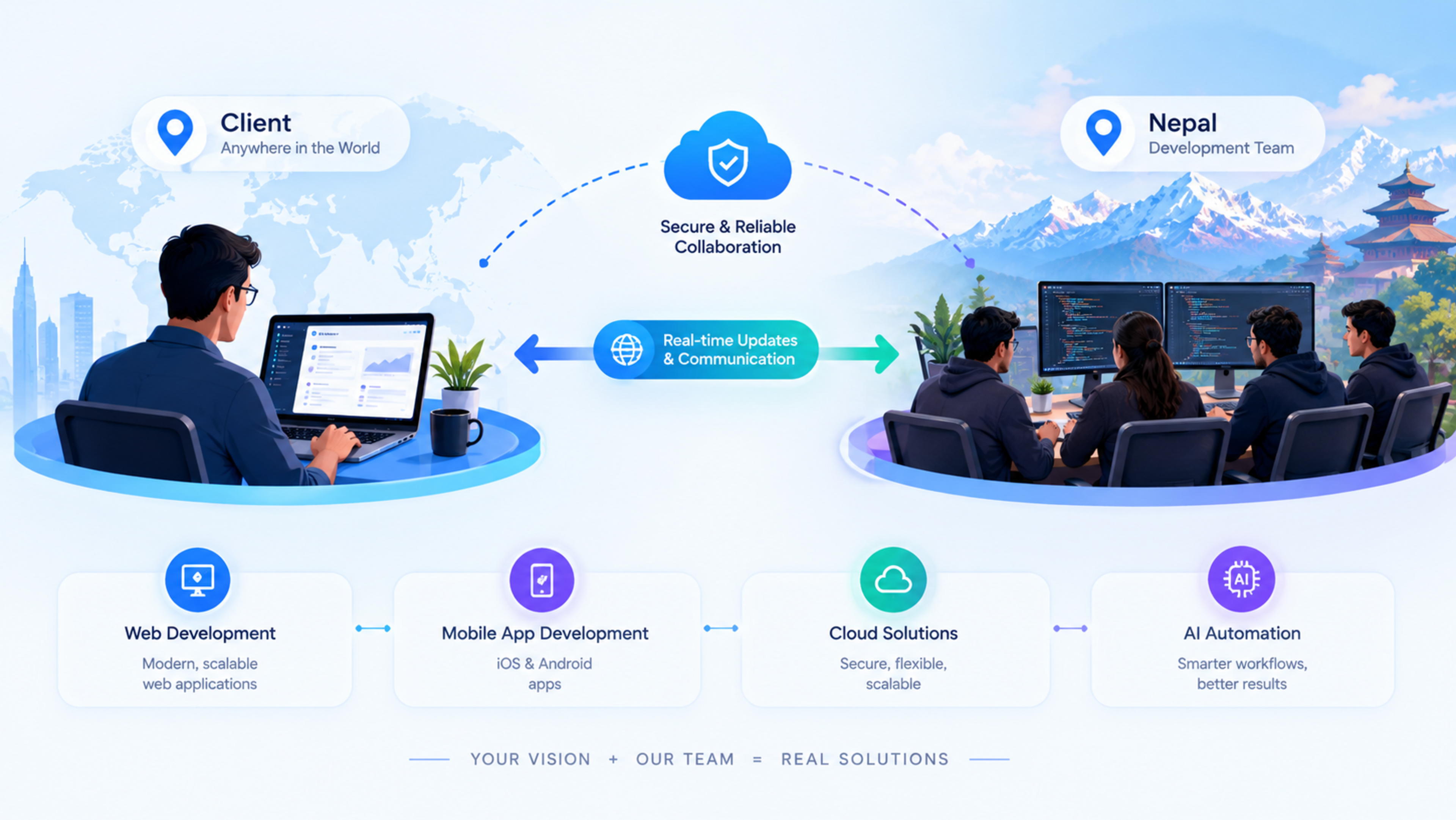
IT outsourcing in Nepal has become an attractive option for businesses that need skilled developers, designers, and technology teams without the cost of building an in-house department. Companies outsource to Nepal for web development, mobile apps, custom software, UI/UX design, cloud services, and AI automation.
Nepal’s IT sector is concentrated largely in Kathmandu, where many companies provide software development, IT consulting, and dedicated development teams for local and international clients. But outsourcing successfully requires more than finding a low-cost developer. You need the right process, communication model, and partner.softnep+1
What is IT outsourcing?
IT outsourcing means hiring an external company or team to handle technology work instead of managing it fully in-house. This can include a complete project, a specific role, or a dedicated team working only for your business.
Common outsourcing models include:
Project-based outsourcing: You hire a company to deliver a defined website, app, or software project.
Dedicated team: You hire developers, designers, and QA specialists who work exclusively on your product.
Staff augmentation: You add external developers to your existing internal team.
Managed services: You outsource ongoing support, hosting, security, monitoring, or maintenance.
Why businesses outsource to Nepal
1. Cost efficiency
One of the main reasons businesses outsource to Nepal is cost. Hiring a full in-house team involves salaries, benefits, office space, equipment, recruitment, training, and management overhead.
Outsourcing allows you to pay for the skills and time you need, when you need them.
2. Access to skilled talent
Nepali IT companies offer services across web development, mobile app development, custom software, UI/UX design, digital marketing, cloud services, and IT consulting.softnep+2
For many projects, you can access a complete team—project manager, designer, frontend developer, backend developer, QA engineer, and DevOps support—without hiring each role separately.
3. Flexible team scaling
Outsourcing makes it easier to scale up or down. For example, you may need two developers for a new product launch, then reduce the team after launch.
This flexibility is useful for startups, agencies, and businesses with changing workloads.
4. Timezone coverage
Nepal operates at Nepal Time (NPT), UTC+5:45. This creates useful working overlap with many parts of Asia, the Middle East, Europe, and Australia.
For clients in Australia and parts of Europe, the time difference can support same-day communication. For US-based clients, planning regular overlap hours is important.
5. Focus on core business
Outsourcing technical work lets your internal team focus on sales, operations, customer service, and business growth. Instead of managing recruitment, developer training, and infrastructure, you can focus on outcomes.
Services you can outsource to Nepal
Nepali IT companies commonly provide:
Business website development
Ecommerce website development
Custom web application development
Mobile app development
UI/UX design
CRM and ERP development
API development and integrations
Cloud architecture and DevOps
Technical SEO
AI automation
Software testing and QA
Website maintenance and support
If you need a custom internal tool, read our case study on how a custom CRM dashboard helped a sales team track leads faster.
How much does IT outsourcing in Nepal cost?
Outsourcing costs depend on the complexity of the project, experience level, technology stack, engagement model, and duration.
Engagement type | Typical cost range | Best for |
|---|---|---|
Small website project | NPR 25,000–250,000 | Business websites, landing pages, simple portals |
Ecommerce project | NPR 150,000–600,000+ | Online stores and product-based businesses |
Custom web application | NPR 400,000–2,000,000+ | CRMs, booking systems, dashboards, SaaS products |
Dedicated developer | Varies by skill and experience | Long-term product development |
Dedicated team | Varies by team size and roles | Startups, agencies, and scaling products |
For a detailed breakdown of website pricing, read our guide on website development cost in Nepal.
Nepal vs other outsourcing destinations
Factor | Nepal | India | Philippines |
|---|---|---|---|
Cost | Generally competitive | Wide range, can be higher for senior talent | Competitive, especially support roles |
Talent focus | Web, mobile, custom software, outsourcing | Large-scale software, enterprise, AI | BPO, customer support, software |
English communication | Good among many IT professionals | Strong | Strong |
Timezone | UTC+5:45 | UTC+5:30 | UTC+8 |
Best suited for | Dedicated teams, custom products, cost-conscious projects | Enterprise and large-scale delivery | Support, BPO, customer service |
Nepal can be especially suitable for businesses that want a dedicated development team, custom product development, or a long-term technology partner rather than only high-volume support services.
How to choose the right Nepali IT partner
1. Check relevant project experience
Do not choose based only on company size or price. Review whether the company has built solutions similar to what you need.
Ask for examples of:
Websites or apps in your industry
Custom dashboards or portals
Payment or booking systems
API integrations
AI automation projects
Long-term product development
2. Meet the actual team
Ask who will work on your project. A strong agency should introduce the project manager, designer, developers, and QA specialist involved.
If the sales team is strong but the delivery team is unclear, ask for more details before signing.
3. Review communication process
Ask how often you will receive updates and which tools the team uses.
A good outsourcing partner should use tools such as:
Slack or Microsoft Teams for communication
Jira, Trello, or ClickUp for task management
GitHub or GitLab for code management
Google Meet or Zoom for meetings
Figma for design collaboration
Google Drive or Notion for documentation
4. Ask for a technical proposal
A proper proposal should include:
Project understanding
Recommended technology stack
Feature list
Development phases
Timeline
Team structure
Payment schedule
Testing approach
Support terms
Assumptions and exclusions
If the proposal is only a one-line price, ask for more detail.
5. Clarify intellectual property ownership
Confirm in writing that you will own the final source code, design files, databases, domains, and third-party accounts after payment.
This is especially important for custom software, SaaS platforms, and long-term products.
6. Start with a discovery phase
A discovery phase reduces risk. It helps both sides agree on scope, priorities, user flows, technical requirements, and budget before full development begins.
For larger products, start with:
Business requirement workshop
User flow and feature planning
Technical architecture review
UI/UX wireframes
MVP scope definition
Development roadmap
7. Use milestones and demos
Break the project into milestones. Ask for regular demos so you can see progress instead of waiting until the end.
A simple milestone plan could be:
Discovery and planning
UI/UX design
Core feature development
Integrations and testing
Launch
Post-launch support
Common outsourcing mistakes
Avoid these mistakes:
Choosing the cheapest quote without comparing scope
Not defining features clearly
Skipping a written contract
Failing to clarify who owns the code and accounts
Giving too much control to one person without documentation
Not planning for maintenance after launch
Assuming AI can replace proper testing and project management
Hiring without checking real client references
Is outsourcing to Nepal right for you?
IT outsourcing in Nepal is a good fit if you:
Want to reduce development costs without sacrificing quality
Need a dedicated team for a long-term product
Have a clear business goal but limited in-house technical staff
Need flexible capacity for a new project
Want to build a custom platform, dashboard, or automation system
Prefer a partner that can handle design, development, SEO, and support together
It may not be the best fit if you need extremely specialised enterprise compliance work, local legal expertise, or a team physically present in your office every day.
How Global IT Services can help
Global IT Services provides web development, custom software development, Next.js applications, UI/UX design, technical SEO, and AI automation services for clients in Nepal and international markets.
If you are considering outsourcing to Nepal, we can help you define the right scope, choose the right technology, and build a reliable development plan.
Frequently Asked Questions
Is Nepal good for IT outsourcing?
Yes. Nepal is a growing destination for IT outsourcing, especially for web development, mobile apps, custom software, UI/UX design, and dedicated development teams. Kathmandu has a large concentration of IT companies and technology professionals.softnep+2
What services can I outsource to Nepal?
You can outsource website development, ecommerce development, custom software, mobile apps, UI/UX design, CRM and ERP systems, cloud services, QA, technical SEO, and AI automation.
How much does it cost to outsource software development to Nepal?
Costs vary by project. Small websites may cost a few hundred dollars, while custom web applications and dedicated teams cost significantly more. The final price depends on features, complexity, team experience, and project duration.
What is a dedicated development team?
A dedicated development team is a group of developers, designers, and other specialists assigned to work only on your project. It is useful for long-term products, startups, and companies that need continuous development capacity.
How do I choose a reliable IT company in Nepal?
Review relevant portfolio work, meet the actual delivery team, ask for a detailed proposal, clarify ownership and support terms, check client references, and start with a discovery phase or smaller paid project.
Feedback & Discussion
Have questions or insights? Share your thoughts below.