
AEO vs SEO vs GEO: What Business Owners Need to Know in 2026
Learn the difference between AEO, SEO, and GEO in 2026. Discover how to optimise your website for Google, AI Overviews, ChatGPT, Perplexity, and AI-generated answers.
AEO vs SEO vs GEO: What Business Owners Need to Know in 2026
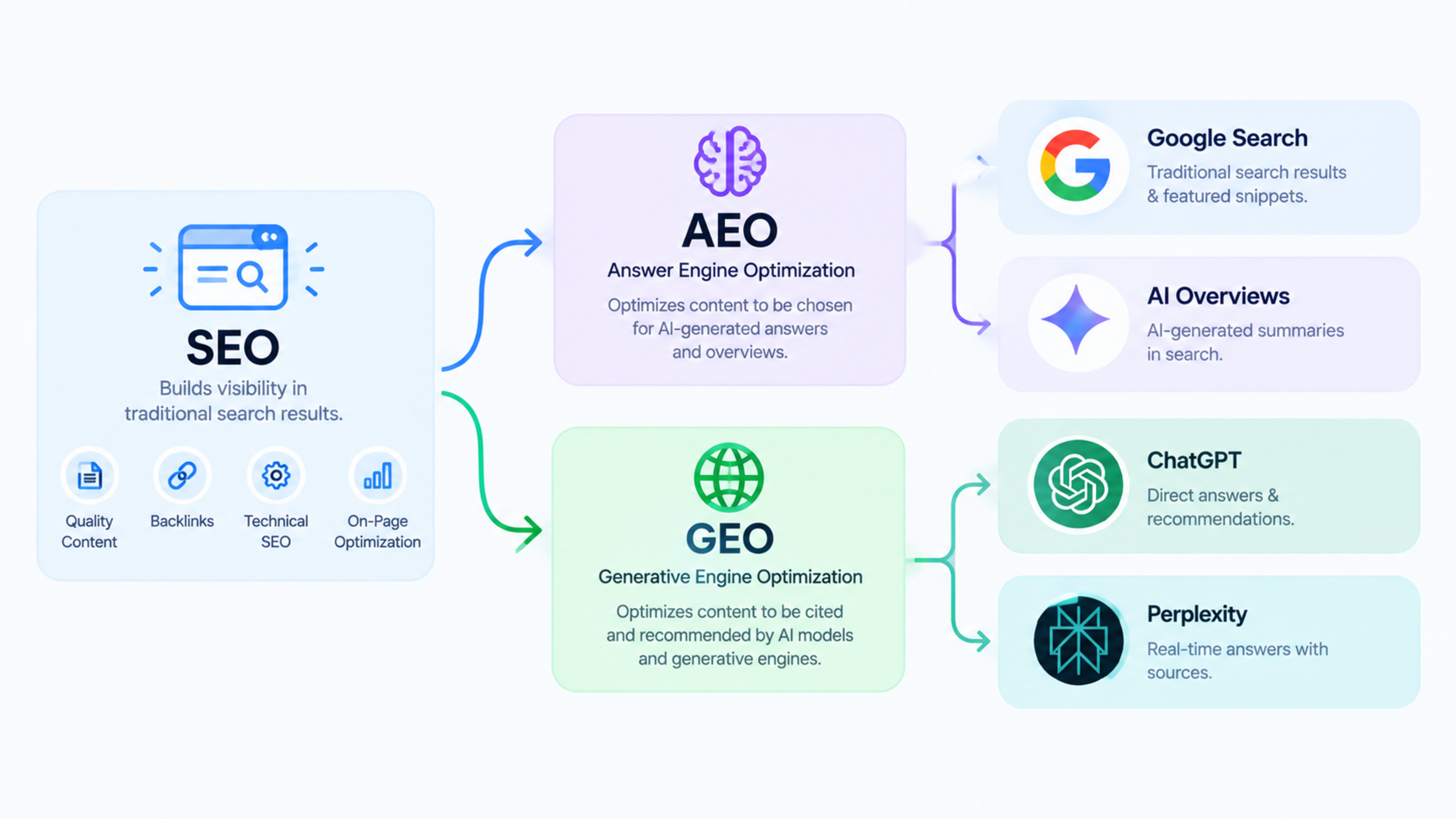
AEO vs SEO vs GEO is one of the most important topics for businesses trying to stay visible as search changes. SEO helps your website rank in traditional search results, AEO helps your content become the direct answer, and GEO helps your brand get cited inside AI-generated responses.
In 2026, business owners cannot rely only on classic Google rankings. AI Overviews, ChatGPT, Perplexity, and other AI-powered search tools increasingly shape how people discover brands, compare services, and make buying decisions.blog.hubspot+1
What is SEO?
SEO, or Search Engine Optimisation, is the process of improving a website so it ranks higher in traditional search engine results. It includes technical SEO, content optimisation, keyword research, internal linking, backlinks, local SEO, and user experience improvements.
SEO remains essential because search engines still send valuable commercial traffic to business websites. Strong SEO helps Google understand your services, trust your website, and match your pages to relevant search queries.blog.hubspot
Main parts of SEO
Technical SEO: Crawlability, indexing, site speed, Core Web Vitals, structured data, and mobile usability.
On-page SEO: Titles, headings, content quality, internal links, and keyword relevance.
Off-page SEO: Backlinks, brand mentions, reviews, and online authority.
Local SEO: Google Business Profile, local citations, reviews, and location-based content.
What is AEO?
AEO, or Answer Engine Optimisation, is the process of structuring content so search engines and AI systems can easily identify and present it as a direct answer.
AEO focuses on clear questions, concise answers, definitions, FAQs, step-by-step instructions, comparison tables, and well-organised headings. The goal is to make your content easy to extract for featured snippets, People Also Ask results, voice search, and AI-generated summaries.surferseo
AEO example
If someone searches, “What is technical SEO?”, a strong AEO-optimised page should provide a short, clear answer near the top of the page:
Technical SEO is the process of improving a website’s technical foundation so search engines can crawl, render, index, and rank it effectively.
After the direct answer, the article can expand with detailed explanations, examples, checklists, and FAQs.
What is GEO?
GEO, or Generative Engine Optimisation, is the process of improving the likelihood that AI systems cite, recommend, or reference your brand when generating answers.
Unlike traditional SEO, GEO is not only about ranking a blue link on Google. It is about becoming a trusted source inside AI-generated responses from tools such as Google AI Overviews, ChatGPT, Perplexity, Gemini, and Copilot.surferseo+1
GEO example
When a user asks an AI tool, “Which company can help with Next.js development and technical SEO?”, GEO helps your business become a credible, relevant source that the AI system can recognise and cite.
AEO vs SEO vs GEO: Key differences
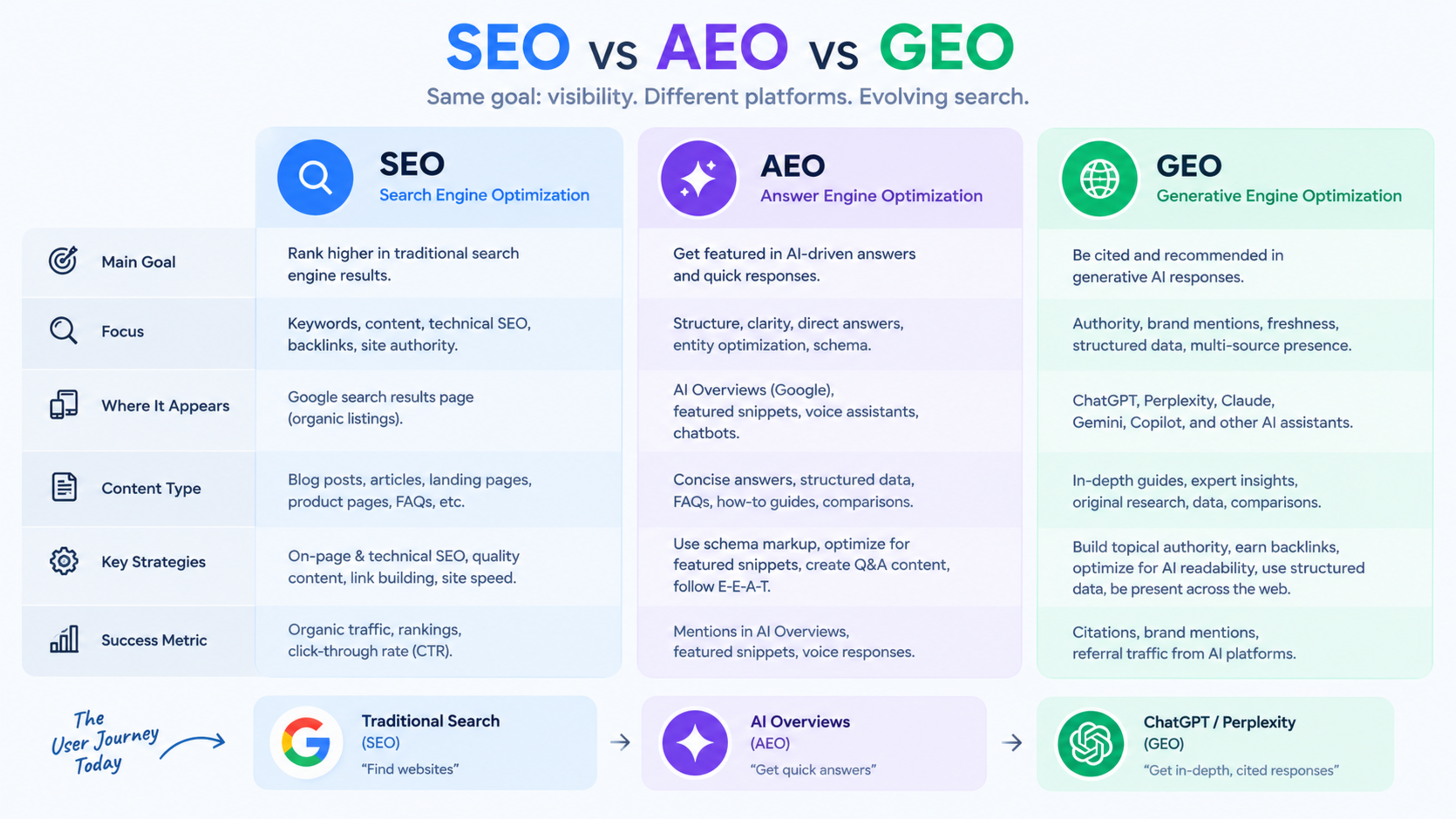
Figure: AEO vs SEO vs GEO overview image
Area | SEO | AEO | GEO |
|---|---|---|---|
Main goal | Rank pages in search results | Become the direct answer | Get cited in AI-generated answers |
Main platforms | Google, Bing, Yahoo | Google, voice assistants, AI search | ChatGPT, Perplexity, Gemini, AI Overviews |
Content style | In-depth, keyword-relevant pages | Clear answers, FAQs, structured sections | Authoritative, factual, entity-rich content |
Technical focus | Crawlability, speed, indexing, schema | Answer extraction, headings, schema | Brand clarity, citations, authority, structured data |
Success metric | Rankings, traffic, conversions | Snippets, answer visibility, engagement | AI citations, brand mentions, referral traffic |
Best for | Long-term organic growth | Question-based searches | AI-first discovery and brand authority |
Why AEO and GEO matter in 2026
AI search is changing user behaviour. People increasingly ask complete questions and expect direct answers rather than browsing through multiple links. This creates more zero-click searches, where users get an answer without visiting a website.blog.hubspot
That does not mean SEO is dead. It means businesses need a broader visibility strategy:
SEO helps you rank.
AEO helps you answer.
GEO helps you get cited.
Together, they improve your chance of being discovered across Google, AI assistants, and generative search platforms.
How to optimise for SEO, AEO, and GEO
1. Start with strong technical SEO
AI systems cannot cite content they cannot access. Make sure your website is crawlable, indexable, mobile-friendly, secure, and fast.
Prioritise:
Clean XML sitemap
Proper robots.txt configuration
Correct canonical tags
Fast Core Web Vitals
Mobile-first design
HTTPS security
Valid structured data
2. Create question-based content
Build content around the real questions your customers ask. Use tools such as Google’s People Also Ask, customer support enquiries, sales calls, and keyword research to identify common questions.
Examples include:
“How much does website development cost?”
“What is technical SEO?”
“Next.js vs WordPress: which is better?”
“How can AI automation help small businesses?”
“How do I improve Core Web Vitals?”
3. Answer questions directly
Place a concise answer immediately after each question-based heading. Then expand with context, examples, steps, and supporting details.
A good structure is:
Ask the question in an H3 heading.
Give a direct answer in the first sentence or two.
Add supporting detail, examples, and internal links.
Finish with a relevant call to action if appropriate.
4. Use structured data
Add schema markup that matches your content. Useful schema types include Article, FAQPage, Service, Organization, BreadcrumbList, Product, and Review.
Structured data helps search engines understand entities, relationships, and page purpose. It also makes content easier for AI systems to interpret.surferseo
5. Build topical authority
Publish clusters of related content instead of random one-off articles. For example, create a topic cluster around technical SEO:
Technical SEO checklist
Core Web Vitals guide
Schema markup guide
Website migration SEO guide
AI search optimisation guide
Next.js SEO guide
Internal links between these articles show search engines and AI systems that your website has deep expertise on the subject.
6. Strengthen E-E-A-T signals
AI systems favour sources that appear credible and authoritative. Show real expertise through author profiles, case studies, client results, certifications, team pages, and original insights.
For technical topics, explain how you tested a solution or implemented it for clients. Original data, screenshots, process diagrams, and practical examples make your content more trustworthy.
7. Keep brand information consistent
Use the same business name, service descriptions, contact details, and positioning across your website, Google Business Profile, LinkedIn, directories, and social platforms.
Consistent entity information helps AI systems connect your brand with the services you provide.
Common AEO and GEO mistakes
Avoid these mistakes:
Writing long introductions before answering the question.
Using vague headings that do not match user intent.
Publishing thin AI-generated content without expertise or original value.
Ignoring technical SEO and assuming AI tools will find every page.
Adding schema markup that does not match visible page content.
Focusing only on Google and ignoring other discovery platforms.
Failing to update outdated statistics, pricing, or service information.
SEO, AEO, and GEO strategy for business websites
A practical 2026 strategy looks like this:
Fix technical SEO foundations.
Identify high-intent customer questions.
Create in-depth guides with direct answers.
Add FAQs, comparison tables, and structured data.
Build service pages around commercial keywords.
Publish case studies that prove real results.
Strengthen author and brand authority.
Monitor rankings, AI citations, branded search, and referral traffic.
This approach supports traditional rankings while also making your website more visible in AI-generated answers.blog.hubspot+1
How Global IT Services can help
Global IT Services helps businesses improve visibility across traditional search and AI-powered discovery through technical SEO, Next.js development, structured content architecture, and AI automation.
If your website is losing visibility to AI Overviews or you want to appear in AI-generated answers, an SEO, AEO, and GEO audit is the best starting point.
Frequently Asked Questions
What is the difference between SEO, AEO, and GEO?
SEO improves rankings in traditional search results. AEO optimises content to become a direct answer in search engines and voice assistants. GEO improves the chance that AI systems cite or recommend your brand in generated responses.
Is AEO replacing SEO?
No. AEO is an extension of SEO, not a replacement. Businesses still need strong technical SEO, quality content, authority, and user experience to perform well in both traditional and AI-powered search.
What is GEO in digital marketing?
GEO stands for Generative Engine Optimisation. It is the practice of making a brand more likely to appear in AI-generated answers from platforms such as Google AI Overviews, ChatGPT, Perplexity, and Gemini.
How can I get my website cited by AI search tools?
Publish clear, accurate, well-structured content; use schema markup; build topical authority; strengthen E-E-A-T signals; and keep your business information consistent across the web.
Is AI search reducing website traffic?
AI search can reduce clicks for some informational queries because users may get answers without visiting a website. However, businesses can still win visibility by creating original, high-value content and optimising for both traditional search and AI-generated answers.
Feedback & Discussion
Have questions or insights? Share your thoughts below.